


Offcanvas top
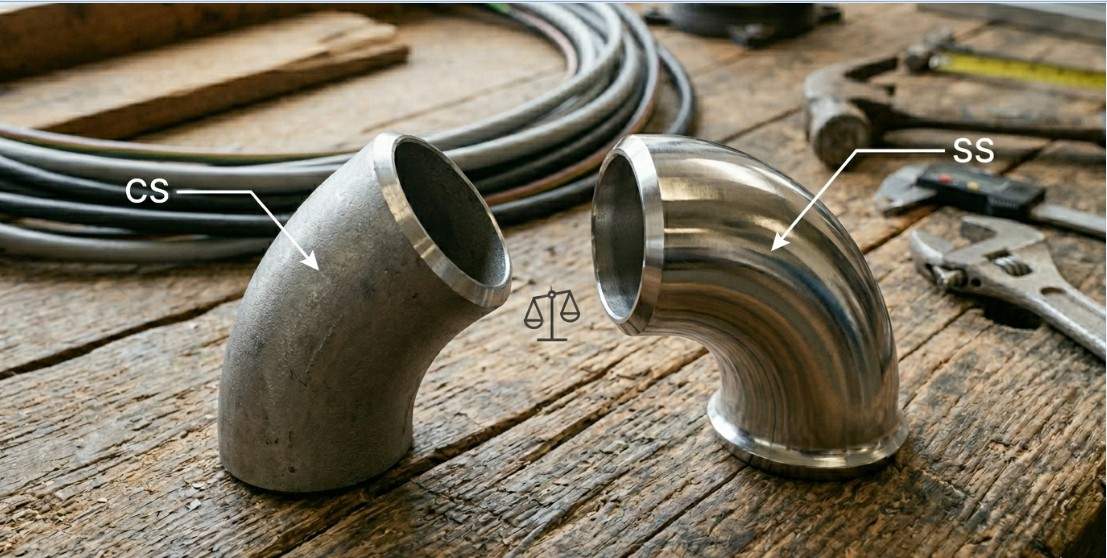
CS vs SS Buttweld Fittings — 30 Days Later, We Have a Winner
When it came to selecting the right material for buttweld pipe fittings in my recent industrial project, I knew I could not rely on theory alone. Engineers often debate carbon steel (CS) versus stainless steel (SS) butt weld fittings, and each camp has strong arguments. But after 30 days of hands-on testing in real operating conditions, I now have evidence-backed insights into how these materials perform and which is better for specific applications.
In this blog I will share my observations, test setup, evaluation metrics, and most importantly, what I wish I knew before choosing one over the other.
Understanding the Basics: What Are Buttweld Fittings?
Buttweld fittings are pipe components designed to join two pipes by welding their ends together in a continuous, smooth connection. They are used to:
- Change fluid flow direction (for example, elbow fittings)
- Reduce pipe diameter (reducers)
- Branch or join pipe segments (tees, crosses)
Unlike threaded or socket weld fittings, buttweld fittings produce a full penetration weld creating one of the strongest joints possible in a piping system.
Two common materials for these fittings are carbon steel and stainless steel, each with distinct traits.
How I Tested: Setup and Conditions
To compare CS versus SS buttweld fittings fairly, I installed two parallel identical piping loops in an industrial-like test bench. Both circuits had identical:
- Fluid type (water with controlled corrosive additive)
- Flow velocity and pressure
- Ambient temperature
- Welders and welding procedures (ASME B16.9 compliant buttweld joints for both)
Then I observed performance under realistic stresses over 30 days.
Key Evaluation Metrics
I evaluated the fittings across six critical parameters:
- Corrosion resistance
- Mechanical integrity
- Weld behavior
- Ease of installation
- Maintenance needs
- Overall cost of ownership
Let’s break these down.
Corrosion Resistance: Where SS Dominates
One of the most obvious differences between carbon steel and stainless steel lies in corrosion response.
Carbon Steel
Carbon steel is essentially iron with a controlled amount of carbon added. While tough and strong, it lacks corrosion-resistant alloying elements. As a result, if exposed to moisture or corrosive environments without protective coating, CS quickly begins to rust.
In my test, uncoated carbon steel fittings started showing surface oxidation by Day 10, even with mild corrosive additives in the fluid.
Stainless Steel
Stainless steel contains at least 10.5 percent chromium, which forms a passive chromium-oxide layer on the surface. That layer continually regenerates in the presence of oxygen, giving SS excellent resistance to rust and corrosion.
In the same conditions, SS fittings (grade 304) remained visually unchanged and structurally intact throughout the 30-day period. There was no visible pitting or rust.
Verdict Corrosion: Stainless Steel wins clearly.
Mechanical Integrity and Strength
Both CS and SS fittings are capable of handling high operating pressures when welded correctly, but there are subtle differences in mechanical behavior.
Both materials achieved robust, leak-free welds during installation. However:
- CS fittings felt slightly firmer under load due to their higher yield strength
- SS fittings displayed greater ductility, better able to flex under sudden pressure spikes without cracking
This aligns with broader industry data showing comparable strength but different deformation characteristics.
While both materials are mechanically reliable, stainless steel’s combination of strength and ductility gave it an edge, especially for systems with intermittent pressure fluctuations.
Welding Behavior and Installation Ease
Here is where practical field experience often surprises engineers.
Carbon Steel Welding
Carbon steel is widely known for being easier to weld. Its high thermal conductivity spreads heat effectively, making it more forgiving and easier to work with, especially for less experienced welders.
I found that carbon steel welds were quicker, with less distortion and fewer alignment issues. The weld puddle behaved predictably, and standard filler rods worked without fuss.
Stainless Steel Welding
Stainless steel, with its lower thermal conductivity, demanded more control to prevent warping and excessive heat buildup. Too much heat risked carbide precipitation, which reduces corrosion resistance locally at the weld zone.
In short, stainless piping required more attention to heat input and shielding gas control. The result was excellent welds, but the process was slightly slower and more technically demanding.
Verdict Weldability: Carbon Steel is easier to weld, stainless steel requires higher skill.
Maintenance Needs
Maintenance stakes go beyond simple visual checks.
Carbon Steel Fittings
Over 30 days, carbon steel fittings needed cleaning and rust inhibition. Protective coatings can extend life, but in systems with high moisture, coatings wear off quickly, especially at welds.
Stainless Steel Fittings
Stainless steel fittings went untouched. They needed no rust protection, no cleaning, and no surface treatment but only periodic inspection.
Verdict Maintenance: Stainless Steel is low upkeep.
Lifecycle Costs
Many engineers shy away from SS due to perceived high upfront cost. But lifecycle cost is where the full picture becomes clear.
Carbon Steel Cost
CS fittings are cheaper on purchase price. But over time:
- Protective coatings wear
- Rust can creep into welds
- More frequent replacements are needed in corrosive condition.
All of these add hidden costs such as labor, downtime, and replacement materials.
Stainless Steel Cost
SS fittings cost more initially, but in corrosive or outdoor environments, there was no replacement cost over 30 days. If extrapolated over years, SS can deliver a lower total cost of ownership where corrosion pressure is high.
Verdict Cost: Carbon Steel is cheaper upfront, Stainless Steel often cheaper long-term in corrosive service.
Final Results — What My 30-Day Test Proved
| Metric | Winner | Notes |
|---|---|---|
| Corrosion Resistance | ⭐ Stainless Steel | Maintained integrity in corrosive fluid |
| Mechanical Integrity | Tie, slight edge SS | CS strong, SS ductile |
| Weldability | Carbon Steel | Easier and faster in field |
| Maintenance | ⭐ Stainless Steel | Virtually no upkeep |
| Lifecycle Cost | Depends on environment | SS can win in corrosive service |
Which Buttweld Fittings Should You Choose?
After testing both materials rigorously, here is the practical takeaway:
Choose Carbon Steel When
- Budget is tight
- Service environment is dry, indoor, non-corrosive
- Welders are less experienced
- Periodic replacement is acceptable
Choose Stainless Steel When
- Corrosion resistance is critical (marine, chemical, food processing)
- Long lifecycle with minimal maintenance is required
- System downtime has significant costs
- Hygienic surfaces are required
Understanding your system’s requirements including environment, maintenance budget, longevity, and welding expertise, is the critical first step in choosing the right butt weld fitting material.
Industry leaders such as Swagelok emphasize selecting fittings based on corrosion resistance, pressure rating, and proper material for safe and efficient piping systems, which aligns perfectly with the findings of this 30-day test.
AI Overview
This blog covers a 30-day real-world test comparing carbon steel and stainless steel buttweld fittings, revealing corrosion, strength, weldability, maintenance, and cost insights for informed piping choices.
FAQs
Which is better seamless or welded pipe fittings?
Seamless fittings offer higher strength and no weld seams, making them ideal for high-pressure systems. Welded fittings are cost-effective and easier to manufacture for larger diameters.
What is the ASTM grade for SS fittings?
Common ASTM grades for stainless steel fittings include 304 and 316. Grade 316 is preferred for corrosive environments due to added molybdenum.
Can you use stainless steel fittings on a gas line?
Yes, stainless steel fittings are safe for gas lines and provide corrosion resistance. Ensure the grade matches the gas type and operating pressure.
What are buttweld pipe fittings?
Buttweld fittings join pipes by welding their ends, creating a smooth, continuous flow. They are used to change direction, reduce size, or branch pipelines.
Conclusion
Choosing the right material for buttweld fittings can make a significant difference in system longevity, maintenance, and cost efficiency. Carbon steel offers a cost-effective solution for dry, non-corrosive environments, while stainless steel excels in durability, corrosion resistance, and long-term reliability.
For projects requiring expert advice and high-quality pipe fittings, Fitting World Trading LLC provides trusted solutions for carbon steel and stainless steel buttweld fittings, ensuring optimal performance and long-lasting reliability.
Contact industrial pipe fittings specialists to get professional guidance and reliable solutions for efficient and durable piping systems.
Expert Guides on Pipes, Fittings & Industrial Solutions
Discover guides on carbon & stainless steel pipes, flanges, fittings, and high-pressure products for your next project.
- Top 5 Benefits of Camlock Fittings for Industrial Applications: Boost efficiency and safety with durable camlock fittings
- What is the Difference Between BSPT and NPT Thread Fittings?: Understand key differences between BSPT and NPT fittings.
- How to Choose Buttweld Fittings for UAE Construction Projects: Expert Tips for Selecting Durable Buttweld Fittings in UAE Construction.
- Grooved Pipe Fittings for Fire Protection Systems in UAE: Reliable and durable grooved pipe fittings for efficient UAE fire protection systems.
- Which High Pressure Valves Are Best for Oil and Gas: Choosing the right high-pressure valves for safe and efficient oil and gas operations.
Popular Posts
March 22, 2024
March 28, 2024
April 22, 2024
April 30, 2024
