


Offcanvas top
Blind Flange: What It Is, Uses & How It Works | Guide
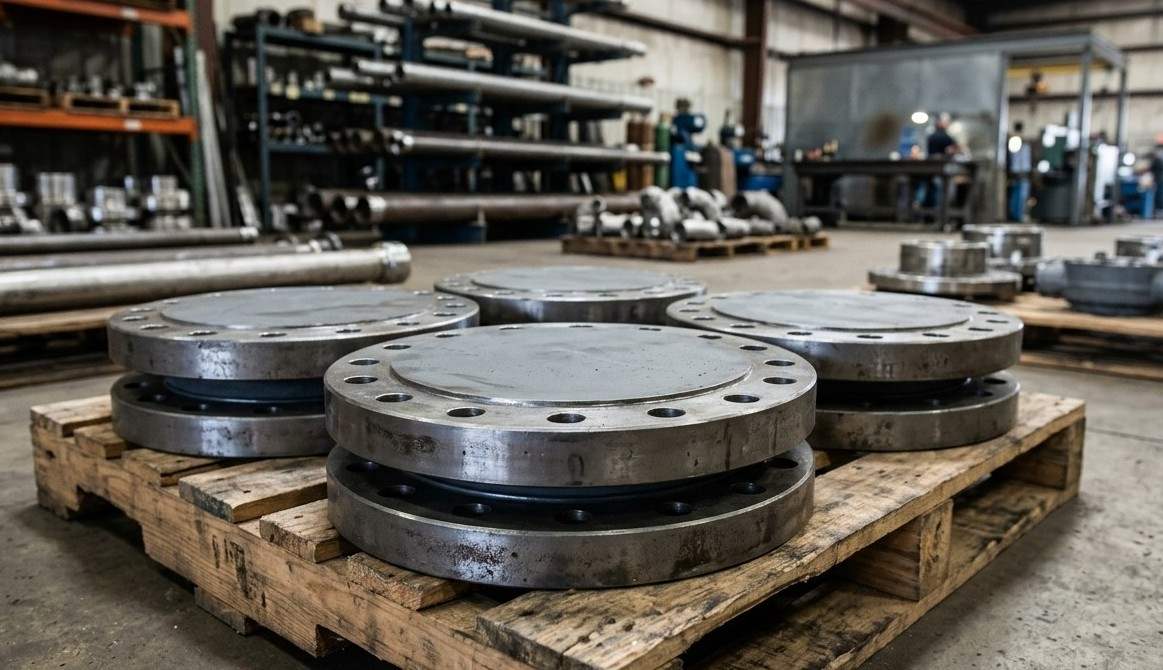
A blind flange is a solid circular steel or alloy plate with bolt holes and no center hole (bore), used to bolt onto the end of a pipe, valve, or pressure vessel nozzle to completely seal the line. It also isolates systems, enables pressure testing, and reserves tie-in points for future expansion.
What Is a Blind Flange?
A blind flange is a pipe flange made as a solid disc. It bolts to a mating flange with a gasket between the faces, creating a pressure-tight seal. Unlike other flange types, it connects to no downstream pipe.
Standard flanges join pipe sections. A blind flange terminates the line while keeping the joint removable. That reversibility is the main reason plants choose it over a welded cap.
Industrial blind flanges follow dimensional standards such as ASME B16.5 for sizes up to NPS 24 and ASME B16.47 for larger diameters. They share bolt patterns and facings with standard flanges, so they fit existing connections without modification.
What Is a Blind Flange Used For?
A blind flange closes pipe ends, isolates sections of a system, and provides access for inspection or cleaning. It also holds a connection point in reserve for future expansion. Because it can be unbolted, it offers a reversible alternative to permanent closures.
Common applications include:
- Closing the end of a pipeline or header
- Sealing unused nozzles on tanks and pressure vessels
- Isolating equipment during shutdowns and maintenance
- Supporting hydrostatic pressure tests
- Providing manway or inspection access on vessels
- Reserving tie-in points for planned system growth
In each case, blind flanges let operators change the system later without cutting or welding.
Where Are Blind Flanges Used?
Blind flanges appear wherever pressurized fluids or gases move through piping. Oil and gas facilities, petrochemical plants, power stations, water treatment works, and shipyards all rely on industrial blind flanges. Any system that needs a sealed, serviceable endpoint is a candidate.
In refineries, they cap spare nozzles on process vessels. In water systems, they terminate branch lines awaiting future connections and in marine piping, they close off redundant outlets. The environments differ, but the need is the same: a dependable seal that maintenance crews can open when required.
How Does a Blind Flange Work?
A blind flange works by compressing a gasket between its sealing face and the mating flange face. Bolts and nuts apply even clamping force, and the solid plate blocks the flow path completely. The seal holds as long as bolt load and gasket integrity are maintained.
Three facing types are common:
- Raised face (RF): The most widely used, suited to general service
- Flat face (FF): Used with cast iron or low-pressure equipment
- Ring type joint (RTJ): Used for high-pressure and high-temperature service
Pressure classes range from 150 to 2500. The class must match the connecting flange and the system’s design pressure and temperature.
A blind flange carries the full end load of line pressure across its solid face. This produces more bending stress than a standard flange experiences, so thickness is usually greater at higher pressure ratings.
What Materials Are Blind Flanges Made From?
Blind flanges are made from carbon steel, stainless steel, alloy steel, and specialty alloys. Material choice depends on the fluid, operating temperature, pressure, and corrosion risk. Matching the flange material to the connecting piping prevents galvanic corrosion and uneven thermal behavior.
Typical options include:
- Carbon steel (ASTM A105): General industrial service and hydrocarbons
- Stainless steel (ASTM A182 F304/F316): Corrosive media, food, pharmaceutical, and marine use
- Alloy steel (F11, F22): High-temperature power and refinery service
- Duplex and nickel alloys: Aggressive chemical and offshore environments
Always verify material certification and heat numbers. Traceability matters most in regulated industries.
How Do You Choose the Right Blind Flange?
Choose a blind flange by matching its size, pressure class, facing, and material to the mating flange and the service conditions. Confirm the applicable standard and gasket type before ordering. A mismatch in any one of these can cause leaks or force a shutdown.
Use this checklist:
- Confirm nominal pipe size and bolt circle dimensions.
- Match the pressure class to the connecting flange and design conditions.
- Select the facing type: RF, FF, or RTJ.
- Verify material compatibility with the process fluid and temperature.
- Check the required standard, such as ASME B16.5 or B16.47.
- Select a compatible gasket and bolting grade.
- Request mill test certificates for critical service.
Supplier selection matters as much as the specification. A dependable blind flanges supplier in Dubai should provide full material traceability, certified test reports, and stock across common sizes and pressure classes.
What Mistakes Should You Avoid With Blind Flanges?
The most common mistakes are mismatched facings, undersized bolting, and uneven bolt tightening. Each one compromises the seal. Following a proper cross-pattern tightening sequence and torque specification prevents most leaks.
Other errors to watch for:
- Reusing damaged or compressed gaskets
- Mixing materials without checking galvanic compatibility
- Ignoring thickness requirements at elevated pressures
- Skipping inspection of sealing surfaces for scratches or pitting
Blind flanges also see long idle periods. Inspect them during scheduled maintenance, because corrosion on a capped line often goes unnoticed until the flange is opened.
Conclusion
A blind flange is a simple component with an important job. It seals pipe ends, isolates equipment, supports testing, and keeps systems ready for future expansion. Selecting the correct size, class, facing, and material ensures a safe, leak-free connection. For buyers looking for a trusted blind flanges supplier in Dubai, Fitting World Trading LLC provides certified industrial blind flanges suited to a wide range of applications.
Get the right blind flange for your project
Want a second opinion on your specification? Our team can review your size, pressure class, facing, and material requirements and recommend suitable blind flanges and fittings.
Frequently Asked Questions
What is the difference between a blind flange and a pipe cap?
A pipe cap is welded onto the pipe end and is difficult to remove. A blind flange bolts on and can be removed repeatedly. This makes blind flanges the better choice when future access, inspection, or expansion is expected.
Can a blind flange handle high pressure?
Yes. Blind flanges are available in pressure classes up to 2500 and beyond. Their thickness increases with the rating because the solid face carries the full end load of the pipeline pressure.
What is the difference between a blind flange and a spectacle blind?
A blind flange is a single solid plate that bolts onto a flanged connection. A spectacle blind has two discs joined by a web, one open and one solid, so operators can rotate between flow and isolation positions without removing it.
Related Reading
- Everything You Need To Know About Grooved Pipe Fittings: A complete walkthrough of grooved fitting types, uses, and installation steps.
- Key Factors to Consider When Choosing the Right Flange: A practical guide to picking the correct flange type, material, and pressure rating for your project.
- Why Stainless Steel Flanges Are the Best Choice for Corrosive Environments: Why chromium and molybdenum content make stainless steel flanges reliable in harsh UAE conditions.
- Spiral Wound Gasket Types, Uses & Applications: A closer look at how spiral wound gaskets seal high pressure and high temperature flange joints.
- Butterfly Valves: Types, Uses & Benefits Guide: How wafer and flanged butterfly valves connect into flanged piping layouts.
Popular Posts
March 22, 2024
March 28, 2024
April 22, 2024
April 30, 2024
