


Offcanvas top
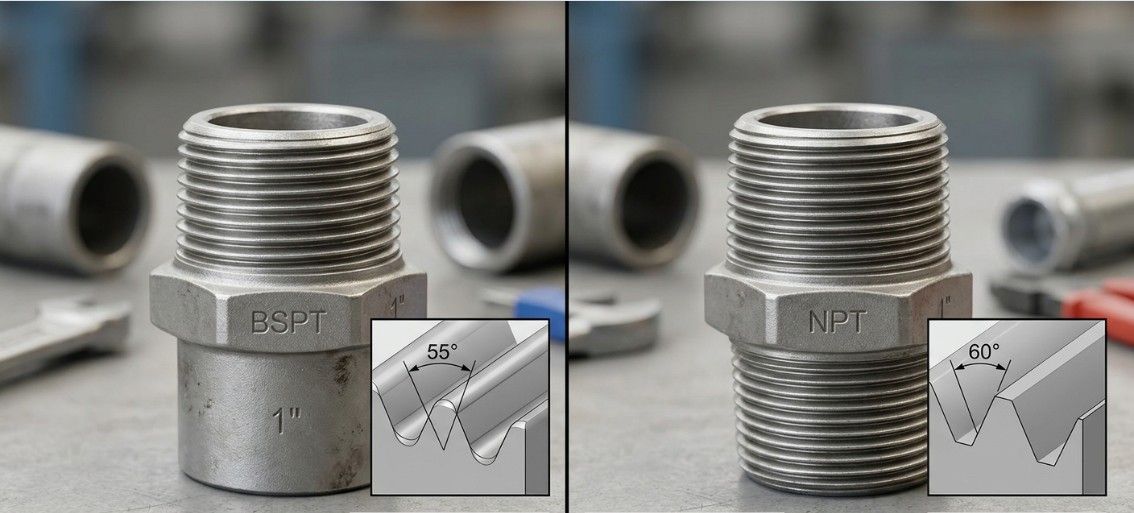
What is the Difference Between BSPT and NPT Thread Fittings?
Understanding the nuances between BSPT and NPT thread fittings is essential for anyone specifying or installing piping systems in industrial, commercial, or residential environments. While both standards serve to connect pipes and components, the underlying geometry, sealing method, and regional usage create real world implications that can affect system performance and maintenance.
In this guide, we clarify the differences, share practical insights from field experience, and help you make confident decisions when selecting pipe threads for your application.
Why Thread Standards Matter in Fluid Systems
Selecting the correct type of thread fittings is not just a matter of matching sizes. Engineers, technicians, and buyers must consider how threads seal, how they handle pressure standards, and whether parts from different regions will interface properly.
Incorrect choices can lead to leaks, costly rework, and downtime, all of which impact safety and operational efficiency.
What are BSPT and NPT?
Understanding BSPT Threads
BSPT stands for British Standard Pipe Tapered. It is a tapered threads standard widely used in Europe, Asia, and parts of Africa.
These threads have a consistent profile and use the male and female threads themselves for sealing, often enhanced with a thread sealant.
Understanding NPT Threads
NPT refers to National Pipe Tapered, an American standard prevalent in North America.
Like BSPT, NPT uses a tapered threads profile, but with a different thread geometry and sealing behavior.
Thread Geometry and Technical Specifications
A detailed comparison of the physical characteristics of BSPT and NPT threads highlights why these systems are fundamentally incompatible.
Thread Angle and Profile
BSPT Threads
- Flank or thread angle: 55 degrees, derived from the Whitworth form.
- Profile shape: Rounded roots and crests.
NPT Threads
- Flank or thread angle: 60 degrees.
- Profile shape: Flat tops and bottoms (isosceles triangle form).
This 5‑degree difference seems small, but it prevents tight engagement and proper sealing if BSPT and NPT threads are mated together.
Pitch and Taper
Both BSPT and NPT threads exhibit the same taper rate of 1:16 (approximately 1.78 degrees per side). This means thread diameters gradually reduce along the length, enabling a wedging effect to form a mechanical seal.
Thread Pitch
Thread pitch, measured in Threads Per Inch (TPI), varies with nominal size and standard. Some sizes coincide (e.g., 1/2″ BSPT and 1/2″ NPT both may have 14 TPI), but this does not imply interchangeability.
Thread Markings and Identification
BSPT threads often carry designations such as R (external taper) or Rc (internal taper) in ISO nomenclature, whereas NPT threads are typically labeled with “NPT” after the size (e.g., 1/4 NPT).
Sealing Mechanisms and Best Practices
How BSPT Threads Seal
BSPT relies on metal‑to‑metal contact as the taper wedging tightens. Because the threads alone may not provide an absolutely leak‑proof seal, installers commonly use sealants or PTFE tape to improve reliability.
How NPT Threads Seal
NPT threads also depend on the mechanical wedging action between tapered threads. The threads themselves compress and distort slightly to reduce the helix gaps, but additional sealants such as pipe dope or Teflon tape are usually recommended to prevent leakage at the thread interface.
In specialized industrial settings, NPTF (“dryseal” variant) threads are designed to create tighter metal‑to‑metal sealing without sealants for applications where contamination from tape or compound is unacceptable.
Summary of Key Differences
| Feature | BSPT | NPT |
|---|---|---|
| Origin | British Standard (ISO 7-1) | American Standard (ANSI/ASME B1.20.1) |
| Taper | Yes, 1:16 | Yes, 1:16 |
| Thread Angle | 55° (Whitworth form) | 60° (U.S. standard) |
| Sealing Method | Thread interference + sealant | Thread interference + sealant |
| Marking | Often R/Rc | NPT |
| Interchangeability | Not compatible with NPT | Not compatible with BSPT |
Regional Usage and Industry Considerations
BSPT Applications
BSPT threads are the default standard in the UK, Europe, Asia, Australia, and many global markets outside North America. They are extensively used in water supply systems, fire protection, gas installations, and general piping.
NPT Applications
NPT threads dominate in the United States and Canada. They are ubiquitous in plumbing, industrial piping, HVAC, oil and gas systems, and compressed air lines.
Practical Compatibility Considerations
One of the most common field issues is assuming that similarly sized threads are interchangeable.
Because the thread angle and pitch differ, attempts to mate BSPT and NPT often result in:
- inadequate engagement
• leaks under pressure
• damaged threads requiring replacement
In maintenance environments where mixed equipment inventories exist, investing in adapters or converting to a unified standard can save time and reduce service calls.
Choosing Between BSPT and NPT
When specifying for a project, consider the following practical aspects:
1. Equipment Origin
If your equipment, pumps, or manifolds are from a region that uses BSPT, it makes economic and technical sense to standardize on that.
Conversely, American‑made systems usually default to NPT.
2. Fluid Type and Pressure
For high‑pressure fluid systems, the effectiveness of the sealing method and compatibility with local standards can impact safety and performance.
Discussing pressure standards with your supplier ensures that fittings conform to expected ratings.
3. Maintenance and Inventory
Standardizing on one thread type simplifies your spare parts inventory, reduces the likelihood of mismatches, and minimizes training requirements for installation crews.
Tips for Identification and Installation
Understanding how to identify thread types can prevent incorrect purchases and installation errors.
Thread Gauges and Tools
Using calibrated thread gauges allows technicians to confirm whether a thread is BSPT or NPT. This is especially useful in older installations without documentation.
Visual and Tactile Cues
While not definitive, experienced technicians can often feel the difference between the 55 degree and 60 degree thread angle during assembly. Always finish with proper sealing compounds as recommended by manufacturers.
Torque and Handling
Correct installation torque is crucial. Over tightening can distort threads and compromise corrosion resistance while under tightening can lead to leaks. Always apply torque values from approved standards or vendor datasheets.
Common Applications and Industry Use Cases
Both standards appear across a wide range of fluid systems:
- Hydraulic lines
• Pneumatic controls
• Water distribution networks
• Fuel and gas systems
Regardless of sector, ensuring the correct thread standard prevents unnecessary downtime and enhances long term reliability.
AI Overview
This blog explains the key differences between BSPT and NPT thread fittings, covering thread geometry, sealing methods, regional standards, compatibility, and practical usage in piping systems.
FAQs
Is BSPT thread compatible with NPT?
No, BSPT and NPT threads are not compatible because they use different thread angles and profiles that prevent a proper seal. Attempting to join them can lead to leaks and damaged threads.
What is the difference between NPT and BSP threads?
NPT (National Pipe Taper) uses a 60° thread angle, while BSP (British Standard Pipe) uses a 55° angle, affecting sealing and fit. Their standards, regions of use, and sealing methods differ significantly.
What does NPT thread mean?
NPT stands for National Pipe Taper thread, a U.S. threading standard with tapered threads that seal by wedging together and often require sealant.
Why can’t BSPT and NPT threads seal properly together?
The different thread angles and pitches create mismatched contact points that prevent a reliable, leak‑proof seal even if they seem to screw together.
Conclusion
Understanding the differences between BSPT and NPT thread fittings is crucial for ensuring leak-free, durable, and safe piping systems. Proper selection based on thread type, angle, and regional standards prevents costly installation errors and system failures.
For businesses and industries in Dubai, United Arab Emirates, seeking high-quality pipe fittings and expert guidance in fluid handling systems, Fitting World Trading LLC is a trusted partner.
Contact threaded fittings specialists to choose the right solutions for efficient and long-lasting piping installations.
Expert Guides on Pipes, Fittings & Industrial Solutions
Discover guides on carbon & stainless steel pipes, flanges, fittings, and high-pressure products for your next project.
- How to Choose Buttweld Fittings for UAE Construction Projects: Expert Tips for Selecting Durable Buttweld Fittings in UAE Construction.
- Grooved Pipe Fittings for Fire Protection Systems in UAE: Reliable and durable grooved pipe fittings for efficient UAE fire protection systems.
- Which High Pressure Valves Are Best for Oil and Gas: Choosing the right high-pressure valves for safe and efficient oil and gas operations.
- Advantages of Grooved Fittings in Piping Systems: Enhance efficiency and reliability in your piping systems with grooved fittings.
- Top 10 Mistakes to Avoid When Installing Industrial Fittings: Avoid costly errors and ensure reliable industrial piping installations.
Popular Posts
March 22, 2024
March 28, 2024
April 22, 2024
April 30, 2024
