


Offcanvas top
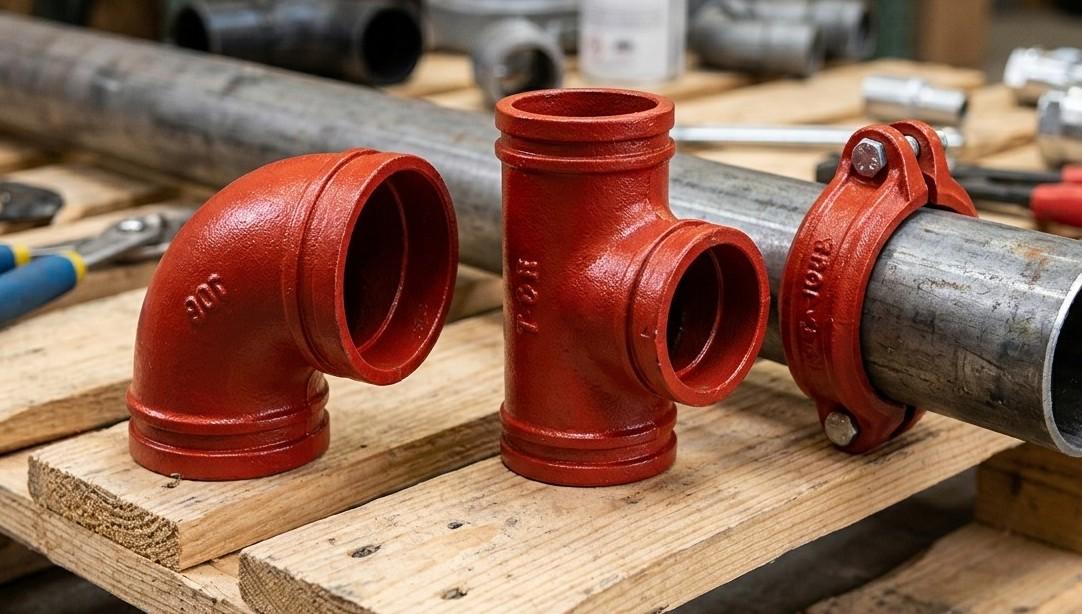
Everything You Need To Know About Grooved Pipe Fittings
If you work anywhere near piping systems, you have probably come across grooved fittings at some point. They show up in fire sprinkler lines, HVAC rooms, water systems and plenty of industrial setups. Yet many people who order or install them still are not fully clear on how they work.
This guide breaks down grooved pipe fittings in plain language, covering what they are, how they are made, the types available, how they compare to threaded and welded joints and where they are used most often.
What Are Grooved Pipe Fittings
A grooved pipe fitting is a mechanical joining system that connects two pipe ends using a groove cut or rolled near the pipe end, a rubber gasket and a metal housing held together with bolts. Instead of welding metal together or cutting threads into pipe, the groove gives the fitting something to grip onto.
The idea was first developed by British engineer Ernest Tribe in the early twentieth century. His invention later grew into the company known today as Victaulic, and the joining method has since become standard practice in piping worldwide.
How Grooved Pipe Fittings Actually Work
The process is simpler than most people expect. The pipe end is first grooved using a roll grooving or cut grooving machine. A rubber gasket is then placed over the pipe end and lubricated slightly to help it seat properly. The coupling housing is positioned over the gasket so its inner edges lock into the groove on each pipe. Bolts are tightened evenly so the housing closes and the gasket compresses to form a tight seal.
As water pressure inside the pipe increases, the gasket actually seals tighter rather than weaker, which is one reason this method is trusted in high pressure systems like fire protection mains.
How Pipe Is Prepared For Grooved Fittings
Grooved pipe is not prepared the same way on every project. Two methods are used and it helps to know how each one affects the pipe before it goes into service.
| Feature | Roll Grooved Pipe | Cut Grooved Pipe |
|---|---|---|
| How the Groove Is Made | Pressed into the pipe wall | Cut away from the pipe wall |
| Pipe Wall Thickness | Stays the same | Slightly reduced |
| Corrosion Resistance | Generally better | Slightly lower due to thinner wall |
| Common Use | Lighter wall steel pipe | Heavier schedule pipe |
| Interior Surface | Small internal ridge | Smooth interior |
Both methods are accepted under recognized piping standards, so the right one for a project usually comes down to pipe schedule, application and site conditions.
Common Types of Grooved Fittings
Grooved systems are not limited to straight couplings. A full range of fittings is available to handle almost any pipe run.
- Grooved couplings, which join two pipe ends together and come in rigid or flexible versions
- Grooved elbows, available in 90 degree, 45 degree and other angles for directional changes
- Grooved tees and crosses, used to branch a line in one or more directions
- Grooved reducers, used to step down from a larger pipe size to a smaller one
- Grooved caps, used to close off the end of a branch line
For directional pipe changes on the same project, our earlier post on elbow pipe fittings and their applications walks through the different angle options.
Since gaskets are central to how every grooved joint seals, our guide on gasket pipe fittings is also worth a read.
Where Grooved Fittings Fit Among Pipe Joining Methods
Every piping project has to choose a joining method, and each option serves a different purpose on site. Threaded connections work well on smaller pipe sizes but take longer to prepare and carry a higher risk of leaks over time. Welded joints, covered in our post on buttweld fittings and their applications, create an extremely strong permanent bond but require skilled labor and hot work permits.
Grooved fittings sit in a practical middle ground. They install faster, need no open flame, and can be visually inspected simply by checking that the bolt pads have closed properly. This is why they are often the preferred choice on large fire protection and HVAC projects with tight schedules.
Benefits Of Choosing Grooved Fittings
The popularity of grooved systems comes down to a handful of real advantages that matter on site every day.
- Faster installation compared to welding or threading, which reduces labor hours
- No hot work permits or open flame needed during installation
- Easy visual inspection through bolt pad alignment
- Simple disassembly for maintenance, repairs or system changes
- Tolerance for minor pipe movement caused by thermal expansion or vibration
These benefits are why grooved systems have become a standard specification item on fire protection and mechanical drawings rather than just an alternative option.
Where Grooved Fittings Are Used Most
Grooved pipe fittings show up across a wide range of industries because they adapt well to different pressures, pipe sizes and environments.
Fire protection systems rely on grooved fittings for both main and branch lines because of the speed and reliability during installation and inspection. HVAC systems use them extensively in chiller plants and mechanical rooms where pipe runs need frequent adjustment. Plumbing and water distribution systems in commercial and industrial facilities also benefit from the reduced installation time.
Material choice matters too. Many grooved systems pair with stainless steel or ductile iron components depending on the environment, and our post on stainless steel pipe fittings explains where that material performs best.
Choosing A Reliable Grooved Fittings Supplier
Not every fitting on the market meets the same manufacturing standard, so sourcing from a supplier who understands certification and application requirements matters. Working with an experienced grooved pipe fittings supplier UAE teams trust helps ensure your project gets fittings rated for the correct pressure and backed by real technical support rather than guesswork.
Before placing an order, confirm the pipe schedule, working pressure and environment of your project so the supplier can recommend the right groove type, gasket material and housing grade for the job.
Conclusion
Grooved pipe fittings have earned their place across fire protection, HVAC and plumbing systems because they solve a real problem, joining pipe quickly and reliably without welding or lengthy threading work. Understanding how roll grooved and cut grooved pipe differ, the fitting types available and how grooved systems fit alongside other joining methods puts you in a better position when planning your next project.
For certified grooved pipe fittings and expert guidance across the UAE and GCC, FW Trading LLC stocks a complete range built for demanding industrial use.
Ready to get started? Reach out to our team today for technical advice or a fast quote.
Expert Guides on Industrial Insights
If you want to deepen your understanding of industrial equipment, material handling, and engineering best practices, explore these related articles.
- How Grooved Pipe Fittings Are Used in UAE Fire Protection Systems: Learn how grooved pipe fittings are used in UAE fire protection systems for secure and efficient pipe connections.
- Complete Guide to Camlock Fittings Types Uses and Material Selection – A breakdown of camlock fitting types and how to choose the right material for your application.
- The Ultimate Guide to Lifting and Rigging Equipment – A complete overview of slings, hoists and rigging hardware used in heavy lifting operations.
- Top 10 Essential Electrical Components and How to Choose Them – A practical rundown of the core electrical parts every project depends on and how to select them correctly.
- Understanding Elbow Pipe Fittings: Types and Their Applications – Explore elbow types, uses, and applications.
Popular Posts
March 22, 2024
March 28, 2024
April 22, 2024
April 30, 2024
