


Offcanvas top
Rigid vs Flexible Grooved Couplings: When to Use Each
Grooved couplings are the backbone of modern mechanical piping systems. They replace the need for welding or threading by locking onto a pre-cut groove around the pipe end, held together by a housing, gasket, and bolts. The result is a fast, reliable joint that can be assembled in minutes.
But not all grooved couplings work the same way. When it comes to rigid vs flexible grooved couplings, the difference is more than a label. Choosing the wrong type for your application can affect system performance, noise levels, structural integrity, and long-term maintenance costs.
This guide breaks down how each type works, where each one belongs, and what to consider before making a selection.
What Is a Rigid Grooved Coupling
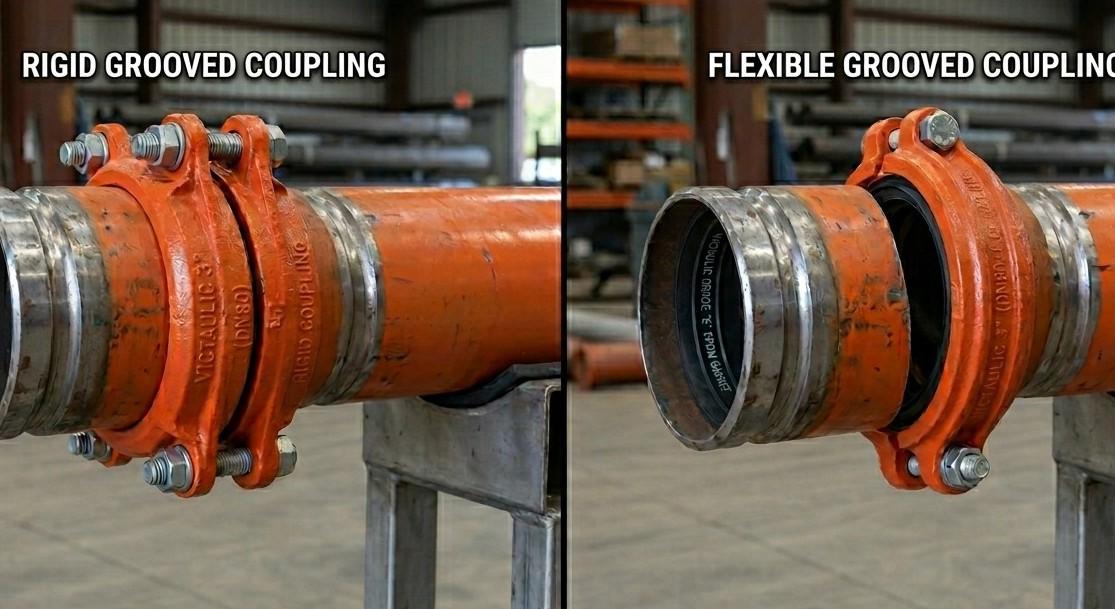
A rigid grooved coupling is designed to hold two pipe segments firmly in place with virtually no movement between them. The housing keys sit deeply into the grooves on both pipe ends, eliminating angular deflection, linear movement, and rotation.
Once tightened, a rigid coupling behaves similarly to a welded or flanged joint in terms of positional stability, but with significantly faster installation.
Key characteristics of rigid grooved couplings include:
- Zero angular deflection once installed
- No axial movement along the pipe length
- High structural rigidity that transfers loads between pipe segments
- Suitability for straight-run piping where no movement is expected
Rigid couplings are the right choice when your piping system must remain fixed in place, carry structural loads, or comply with strict layout tolerances.
What Is a Flexible Grooved Coupling
A flexible grooved coupling allows a controlled degree of movement between connected pipe ends. The housing keys sit at a shallower engagement angle, permitting slight angular deflection, axial movement, and minor rotation within defined limits.
This built-in flexibility is not a weakness. It is an engineered feature that absorbs vibration, accommodates thermal expansion, and isolates noise from pumps and mechanical equipment.
Key characteristics of flexible grooved couplings include:
- Angular deflection of up to 3 to 4 degrees depending on pipe size
- Axial movement to absorb pipe expansion and contraction
- Vibration dampening through the elastomeric gasket
- Noise isolation between mechanical equipment and the piping system
Flexible couplings are the right choice when your piping must handle movement, vibration, thermal cycling, or seismic activity.
Rigid vs Flexible Grooved Couplings at a Glance
| Feature | Rigid Grooved Coupling | Flexible Grooved Coupling |
|---|---|---|
| Angular Deflection | None | Up to 3 to 4 degrees |
| Axial Movement | None | Permitted within limits |
| Vibration Isolation | No | Yes |
| Noise Reduction | No | Yes |
| Structural Load Transfer | Yes | Limited |
| Best Use Case | Straight runs, risers | Near pumps, seismic zones, HVAC |
| Thermal Expansion Handling | No | Yes |
Where Rigid Grooved Couplings Are Used
Rigid grooved couplings are preferred in piping systems where strength, stability, and alignment are the main requirements.
- Fire Protection Systems: Commonly used in branch lines, cross mains, and feed mains where rigid pipe connections are required.
- Vertical Risers: Help maintain pipe alignment and structural stability between floors.
- Long Horizontal Runs: Keep piping properly aligned over extended distances.
- High-Pressure Industrial Lines: Reduce pipe movement that could place stress on fittings and equipment connections.
If you are designing or installing fire protection systems, learn more about grooved pipe fittings in UAE fire protection systems to better understand where rigid and flexible couplings fit within the overall piping network.
Where Flexible Grooved Couplings Are Used
Flexible grooved couplings are used in piping systems that experience movement, vibration, or temperature changes.
- Pump Connections: Prevent vibration from pumps and rotating equipment from traveling through the piping system.
- HVAC Systems: Common in chilled water and hot water networks where pipes expand and contract due to temperature changes.
- Seismic Applications: Allow controlled movement in piping systems located in seismic zones.
- Mechanical Equipment Rooms: Help reduce vibration, noise, and thermal stress around equipment.
- Underground Piping: Accommodate minor pipe movement caused by ground settlement.
When selecting components for your project, working with a grooved pipe fittings supplier provides access to flexible and rigid couplings, along with elbows, tees, reducers, and end caps required for a complete piping system.
How to Decide Which Type You Need
Choosing between rigid and flexible grooved couplings depends on the location and function of the piping section.
Use rigid couplings for:
- Straight horizontal and vertical pipe runs
- Seismic brace locations requiring fixed support
- Areas where pipe deflection must be minimized
Use flexible couplings for:
- Connections near pumps and compressors
- Piping systems requiring thermal expansion movement
- Pipe sections crossing building expansion joints
- Seismic applications specified by the project engineer
Most piping systems use a combination of both coupling types. For example, an HVAC chilled water system may use flexible couplings near pumps to absorb vibration and rigid couplings throughout the main distribution network.
For a broader understanding of mechanical pipe jointing solutions, read our Viking Johnson VJ Couplings guide, which explains how coupling designs accommodate pressure, movement, and pipe alignment in industrial piping systems
Material and Pressure Considerations
Rigid and flexible grooved couplings are commonly manufactured from ductile iron, with stainless steel and carbon steel options available for corrosive or demanding environments. The material does not determine whether a coupling is rigid or flexible; that depends on its design.
Pressure ratings vary according to pipe size, wall thickness, and coupling grade. Standard ductile iron couplings are suitable for most fire protection, HVAC, and industrial water systems. Always verify the coupling’s pressure rating against system requirements.
Gasket selection is equally important. EPDM is widely used for water and HVAC applications, nitrile is suitable for oil and fuel systems, and silicone is preferred for high-temperature services.
Common Mistakes to Avoid
A common mistake is using rigid couplings throughout an entire system, including near pumps and mechanical equipment. This can increase vibration, noise, and equipment wear.
On the other hand, installing flexible couplings at seismic brace locations can reduce the effectiveness of the bracing system.
Always follow the manufacturer’s installation guidelines and project specifications. If there is uncertainty, consult the system engineer before selecting or replacing coupling types.
Conclusion
Grooved couplings offer a fast, reliable, and flexible alternative to traditional welding or threading. Rigid types hold the line firm and carry structure. Flexible types absorb what rigid types cannot, movement, vibration, and thermal change. Used together in the right locations, they make a piping system both stable and resilient.
For certified, high-quality components across the UAE and GCC, FW Trading LLC supplies a comprehensive inventory tailored to your project’s pressure and material needs. Ready to get started? Contact us today for technical guidance or a quick quote.
Expert Guides on Industrial Insights
If you want to deepen your understanding of industrial fittings, piping systems, and engineering best practices, explore these related articles:
- 5 Reasons Camlock Fittings Are Ideal for Industrial Use – Learn why camlock fittings are widely preferred for fast, secure, and leak-free industrial connections.
- The Complete Guide to Camlock Fittings: Types and Uses – A detailed breakdown of camlock fitting types and their applications in industrial systems.
- The Best High Pressure Valves for Oil and Gas Applications – Explore high-performance valves designed for safety and reliability in oil and gas operations.
- 10 Common Installation Mistakes That Can Damage Industrial Fittings – Discover key installation errors that lead to system failure and how to avoid them.
- Why Grooved Fittings Are a Smart Choice for Piping Systems – Understand the advantages of grooved fittings in modern piping networks, including speed and efficiency.
Popular Posts
March 22, 2024
March 28, 2024
April 22, 2024
April 30, 2024
