


Offcanvas top
9 Common Causes of Flange Leaks in Piping Systems
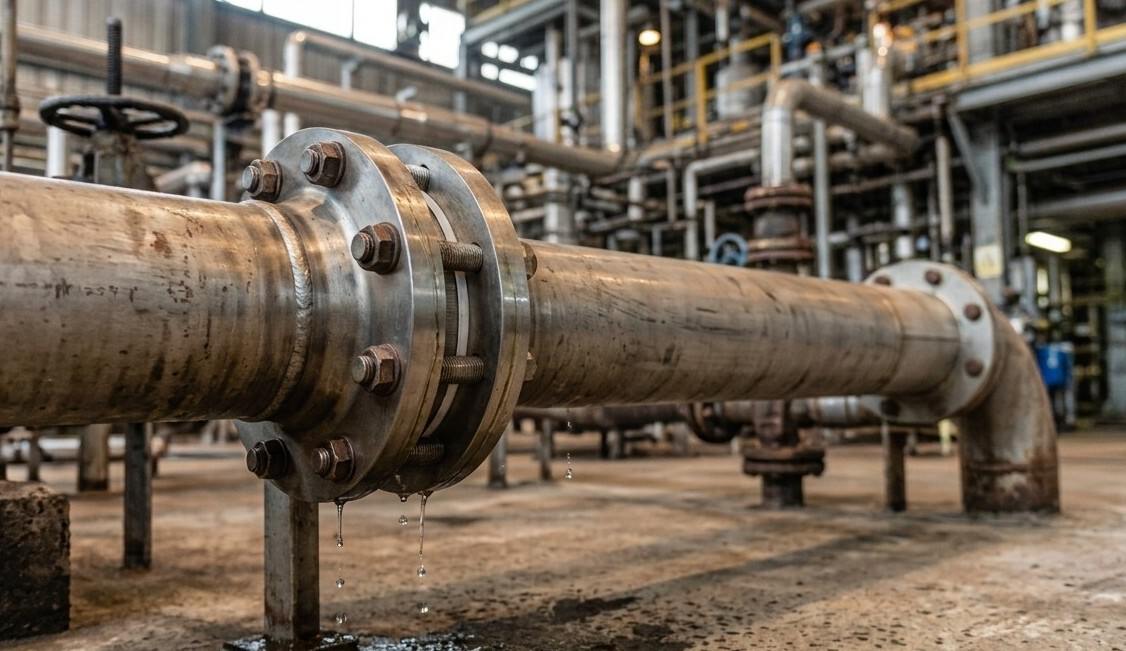
Flange leaks are one of the most common problems piping teams deal with in oil and gas, petrochemical, and construction projects. A leak might start small, a faint drip or a hint of moisture, but if the root cause isn’t fixed, it usually gets worse and can lead to downtime or safety issues.
The good news is that almost every flange failure traces back to one of a small, repeatable set of 9 causes of flange leaks. Once you know what to look for, they’re fairly easy to prevent.
A flange only seals properly when the gasket is compressed evenly between two flat, clean surfaces. When that balance is disturbed, even slightly, a leak path can form. Below are the 9 causes of flange leaks that piping teams run into most often.
1. Uneven Bolt Tightening
When some bolts carry more load than others, the gasket compresses unevenly around the flange. That imbalance creates a low-pressure zone where fluid or gas can start to seep through.
2. Misaligned or Non-Parallel Flange Faces
If the two flange faces aren’t parallel, the gasket gets crushed on one side and left loose on the other. This is one of the more overlooked causes of flange leaks because the joint can look fine from the outside.
3. Off-Center Gasket Installation
A gasket that isn’t centered on the bolt circle won’t compress evenly. Part of the gasket ends up overloaded while the rest barely seals at all.
4. Dirty, Scratched, or Corroded Flange Faces
Pitting, scale, weld spatter, or old gasket material left on the sealing surface all create tiny leak paths that no amount of bolt torque can close.
5. Excessive Piping Loads on the Joint
When pipework isn’t properly supported, weight from valves, fittings, or the pipe run itself gets transferred straight into the flange, bending it slightly and reducing gasket contact.
6. Wrong Gasket Size or Material for the Job
A gasket that’s the wrong size is usually caught during installation, but the wrong material for the fluid, pressure, or temperature often isn’t caught until it’s already leaking, or worse, corroded through.
7. Sudden Temperature Swings
Rapid heating or cooling causes flanges to expand or contract unevenly, warping the joint slightly and loosening bolt stress at the worst possible moment.
8. Excessive Vibration From Nearby Equipment
Pumps, compressors, and other rotating equipment can shake bolts loose over time, even if the joint was torqued correctly at installation.
9. Reusing an Old Gasket
Once a gasket has been compressed and the joint opened, it has already lost the material properties it needs to seal again. Reusing it is one of the most avoidable causes of flange leaks.
Any one of these on its own can start a leak. In real-world cases, it’s often two or three of them working together, for example, a slightly misaligned flange combined with uneven bolt tightening.
Cause and Fix at a Glance
| # | Common Cause | Practical Fix |
|---|---|---|
| 1 | Uneven bolt stress | Tighten bolts in a crisscross pattern using a calibrated torque wrench |
| 2 | Misaligned flange faces | Check parallelism before bolt-up and correct alignment |
| 3 | Off-center gasket | Use a gasket sized to seat evenly against the bolt circle |
| 4 | Damaged flange faces | Clean and inspect surfaces before every reassembly |
| 5 | Excessive piping loads | Ensure proper support and flexibility in the piping design |
| 6 | Wrong gasket material or size | Match the gasket to the fluid, pressure, and temperature |
| 7 | Thermal shock | Recheck bolt tension after temperature stabilizes |
| 8 | High vibration | Add damping and recheck bolt tension on a schedule |
| 9 | Reused gasket | Always install a new gasket at reassembly |
Steps That Actually Prevent Repeat Leaks
Most experienced piping teams follow a fairly consistent process once a joint has leaked more than once.
- Inspect the flange face for pitting, scratches, or warping before reassembly
- Confirm the gasket is centered and the correct size for the bolt circle
- Hand tighten bolts first, then torque them in stages using a crisscross sequence
- Recheck bolt tension after a short run in period, especially on new installations
- Keep records of any joint that leaks more than once, since repeat failures usually point to a design issue rather than a one time mistake
Skipping any of these steps is usually how a joint ends up back on the maintenance list within a few months.
Choosing the Right Flange for the Job
The flange itself plays just as big a role as the gasket. A weld neck flange handles high pressure and cyclic loading well, while a slip on flange is easier to install where precise pipe length isn’t critical. A blind flange is used to seal the end of a pipe run completely, and a socket weld flange suits smaller diameter, high pressure lines where a strong weld is needed.
Using a flange that isn’t rated for the actual service conditions is one of the quieter causes of flange leaks, since the problem often doesn’t show up until the system is under real pressure.
A Quick Word on Safety
Flange leaks aren’t just a maintenance inconvenience. In high pressure or high temperature systems, a sudden leak can put people at risk and cause serious damage to nearby equipment.
Regular inspection, correct torque procedures, and using the right materials from the start go a long way toward keeping a plant both efficient and safe.
Conclusion
Stopping the 9 causes of flange leaks for good comes down to getting the basics right every time. Correct bolt tightening, proper flange alignment, clean flange faces, and a gasket that actually matches the service conditions will prevent most of the leaks that plague piping systems.
Fitting World Trading LLC supplies a wide range of flanges and gaskets built for demanding piping applications across Dubai, the UAE, and the GCC.
Ready to get started? Reach out to our team today for technical advice or a fast quote..
Best Selling Products
- Weld Neck Flange — Built for high pressure and cyclic loading applications
- Slip On Flange — Easier installation where precise pipe length isn’t critical
- Blind Flange — Used to seal the end of a pipe run completely
- Socket Weld Flange — Suited to smaller diameter, high pressure lines
- Spiral Wound Gasket — A reliable choice for high pressure and chemical service
- Ring Joint Gasket — Used in oil and gas systems running at very high pressure
Popular Posts
March 22, 2024
March 28, 2024
April 22, 2024
April 30, 2024
