


Offcanvas top
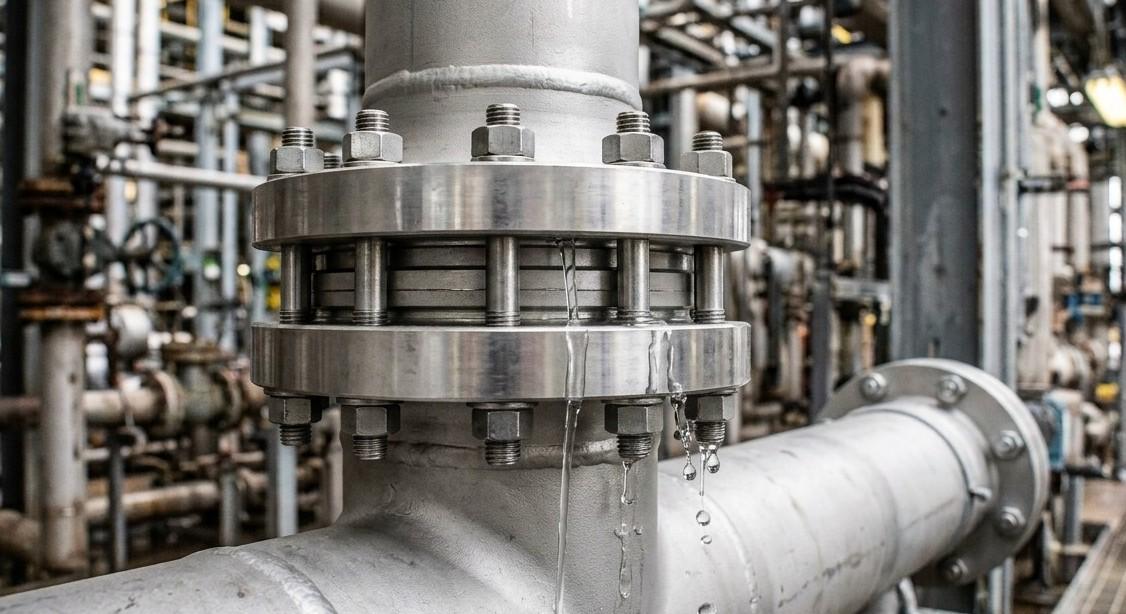
What Causes Flange Leaks and How to Fixed Them
A flange joint looks simple from the outside. Two flat metal faces, a gasket in between, and a ring of bolts holding everything together. Yet this small connection point is often where an entire piping system starts to fail.
Anyone who has worked around pipelines in the UAE, whether in oil and gas, construction, or general industrial plants, has seen a flange weep or fail at the worst possible moment. Understanding the common causes of flange leaks and their solutions is not just a maintenance topic. It directly affects safety, uptime, and the cost of running a facility.
This guide breaks down what actually causes flanges to leak, backed by field experience and industry standards like ASME PCC1, and walks through the fixes that hold up in real operating conditions.
What Happens Inside a Flange Joint
A flange seals properly when the gasket sits evenly compressed between two clean, flat surfaces. Bolts apply the clamping force, and that force has to stay balanced across the entire joint for the seal to hold.
The moment that balance shifts, even slightly, a tiny gap opens somewhere around the gasket. That gap becomes a leak path. Some leaks show up immediately during pressure testing. Others take months of thermal cycling or vibration before they appear.
Uneven Bolt Tightening
This is the single most common reason flanges leak. When bolts are tightened randomly instead of in a proper crisscross sequence, some carry far more load than others. This single issue sits at the top of the list when people search for the common causes of flange leaks and their solutions.
The overloaded bolts crush the gasket on one side while the underloaded bolts leave the other side loose. In high temperature service, the heavily loaded bolts eventually relax, and that is usually when the leak becomes visible.
Fixing this is straightforward.
- Tighten bolts in a star or crisscross pattern, never in a circle
- Use a calibrated torque wrench and follow the manufacturer’s torque value
- Apply the load in stages, roughly thirty percent, then sixty percent, then full torque
Flange Misalignment and Surface Damage
If the two flange faces are not parallel, or the pipe centerlines do not line up, the gasket compresses unevenly no matter how carefully the bolts are torqued.
Dirty or scarred flange faces cause the same problem. Weld spatter, old gasket material, pitting corrosion, and scratches all create tiny channels that a gasket cannot seal against.
A trained crew should always clean and visually inspect both flange faces before installing a new gasket. Skipping this step is a quiet contributor to many of the common causes of flange leaks and their solutions that get overlooked during routine maintenance.
Operating Stress on the Joint
Even a perfectly installed flange can start leaking once real operating conditions kick in. These operating stresses are just as important as installation errors when reviewing the common causes of flange leaks and their solutions.
Excessive piping loads, caused by poor pipe support or a lack of flexibility, transfer bending forces directly into the flange. Rapid temperature swings warp the joint slightly and reduce bolt tension right when it matters most. Vibration from nearby pumps or compressors gradually loosens bolts even on joints that were torqued correctly at startup.
Knowing how to stop a leaking flange in these situations usually means addressing the piping design or the vibration source, not just retightening the joint again and again.
Quick Reference for Diagnosis
| Symptom | Likely Cause | First Action |
|---|---|---|
| Leak appears right after startup | Uneven bolt torque or bad alignment | Recheck torque sequence and alignment |
| Leak develops after months of service | Gasket aging or vibration loosening | Inspect gasket condition and bolt tension |
| Leak worsens with temperature changes | Thermal shock or mismatched materials | Review gasket material rating |
| Leak near a support or fitting | Excessive piping load | Check pipe supports and flexibility |
This kind of table mirrors what many technical guides describe as the critical causes of flange leaks and how to fix them, since the diagnosis process stays consistent across industries and pressure classes.
Preventive Steps That Actually Reduce Leaks
Most experienced maintenance teams in the UAE follow a similar routine once they understand the common causes of flange leaks and their solutions well enough to plan ahead rather than react.
- Schedule regular visual inspection of flange faces and gaskets
- Keep a torque wrench calibration record for every bolt up crew
- Match gasket material to the exact fluid, pressure, and temperature profile
- Support piping properly to remove excess load from flange joints
- Replace gaskets at every disassembly, without exception
None of these steps are complicated on their own. What actually prevents leaks is doing them consistently, every time a joint is opened, rather than only after a failure.
Conclusion
Most flange leaks trace back to a small number of repeatable mistakes. Uneven bolt tightening, poor alignment, and damaged flange faces account for the vast majority of failures seen across piping systems in the UAE and beyond. Getting the basics right during installation and staying consistent with inspection routines prevents most of these issues before they start.
Fitting World Trading LLC supplies a wide range of flanges and gaskets built for demanding piping applications across Dubai, the UAE, and the GCC.
Ready to get started? Reach out to our team today for technical advice or a fast quote.
Expert Guides on Industrial Insights
If you want to go deeper into flange selection, materials, and piping best practices, these guides from our blog cover related ground.
- Everything You Need To Know About Grooved Pipe Fittings: A complete walkthrough of grooved fitting types, uses, and installation steps.
- Key Factors to Consider When Choosing the Right Flange: A practical guide to picking the correct flange type, material, and pressure rating for your project.
- Why Stainless Steel Flanges Are the Best Choice for Corrosive Environments: Why chromium and molybdenum content make stainless steel flanges reliable in harsh UAE conditions.
- Spiral Wound Gasket Types, Uses & Applications: A closer look at how spiral wound gaskets seal high pressure and high temperature flange joints.
- Butterfly Valves: Types, Uses & Benefits Guide: How wafer and flanged butterfly valves connect into flanged piping layouts.
Popular Posts
March 22, 2024
March 28, 2024
April 22, 2024
April 30, 2024
