


Offcanvas top
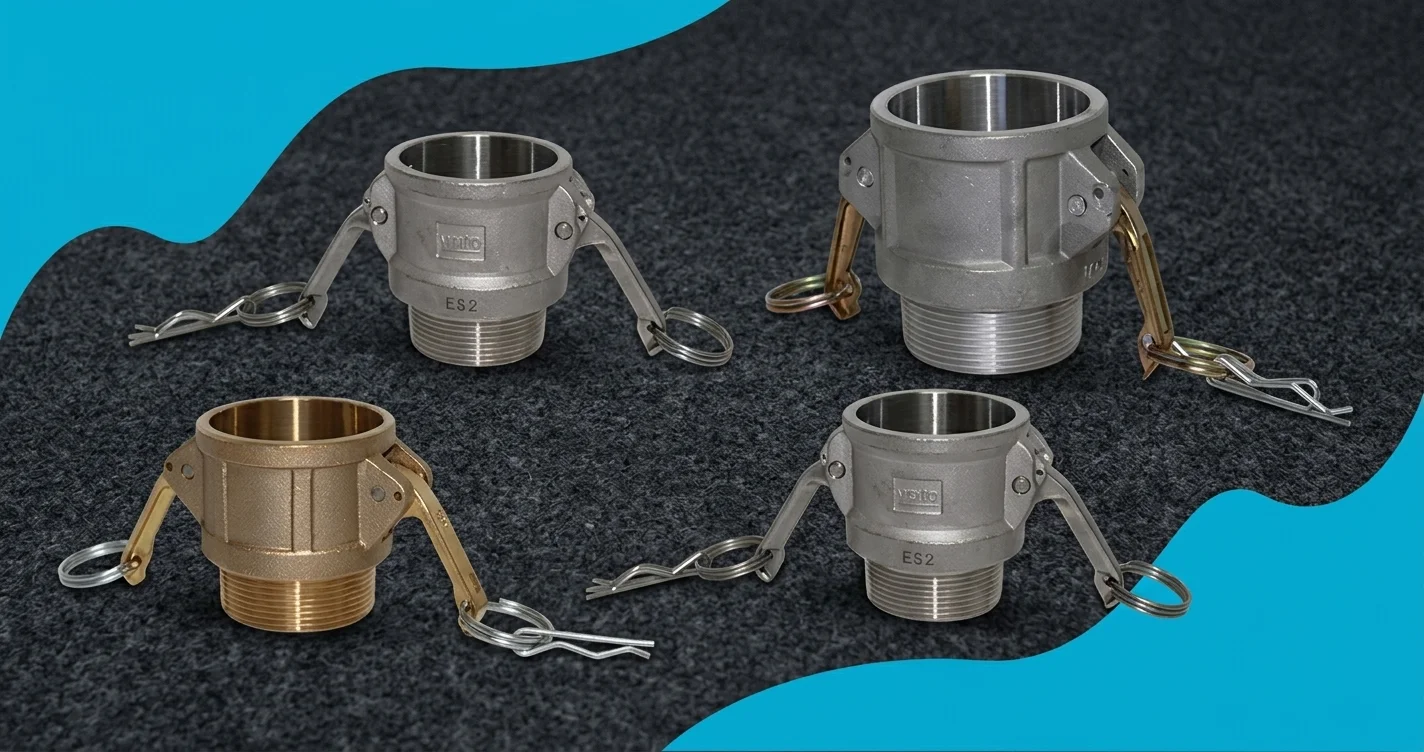
How to Measure Camlock Fittings | Size & Thread Guide
Camlock fittings provide quick and reliable connections for industrial fluid transfer systems. However, incorrect selection or poor handling can lead to leaks and equipment damage. This guide explains the common mistakes to avoid when using camlock fittings and shares practical tips for proper installation, material selection and routine maintenance.
Camlock fittings are widely used in industrial fluid transfer systems because they allow hoses and pipes to connect quickly without complicated tools. They are commonly found in applications involving water, fuel, chemicals and other fluids. However, selecting the correct fitting requires more than simply checking its overall size. The connection type, internal bore, male plug diameter and hose or thread dimensions must also match the existing equipment.
Knowing how to measure camlock fittings helps prevent incorrect orders, connection mismatches and unnecessary replacement costs. Whether you are checking a female coupler, male adapter, hose shank or threaded connection, using the right measuring method makes it easier to identify a suitable fitting. This guide explains the tools, measurement steps and common sizing mistakes to check before choosing a replacement.
How Do You Measure Camlock Fittings?
To measure camlock fittings, identify whether you have a female coupler, male adapter, hose shank or threaded connection. Use a digital caliper to measure the relevant inside or outside diameter, then compare the result with a standard camlock sizing chart.
For a female coupler, measure the internal bore. For a male adapter, measure the outside diameter of the smooth plug section. If the fitting has a hose shank or threaded end, measure that connection separately to confirm compatibility with your hose or pipe.
The important point is to distinguish the nominal camlock size from the dimensions of its other connection ends. A fitting may have a 2-inch camlock connection with a different thread or hose connection size.
What Should You Know Before Measuring a Camlock Fitting?
Before taking measurements, identify the fitting type and understand which part needs to connect to your existing equipment. Camlock fittings are available in different configurations, and each one has a different combination of male or female ends.
Understanding Camlock Fitting Types A, B, C, D, E, F, DC and DP
The common camlock configurations include:
- Type A: Male adapter with a female threaded connection.
- Type B: Female coupler with a male threaded connection.
- Type C: Female coupler with a hose shank.
- Type D: Female coupler with a female threaded connection.
- Type E: Male adapter with a hose shank.
- Type F: Male adapter with a male threaded connection.
- Type DC: Dust cap used to cover a female coupler.
- Type DP: Dust plug used to protect a male adapter.
Identify both ends before measuring. For example, a Type C fitting has a female camlock end and a hose shank. You need to measure the camlock connection and the hose connection separately.
Understanding Nominal Camlock Fitting Size
The nominal camlock size identifies the coupling size used to match compatible male and female components. It does not necessarily represent the outside diameter of the fitting body, hose shank or threaded end.
For example, a 2-inch camlock fitting may have a male plug outside diameter greater than 2 inches. This is why you should compare your measurement with a camlock dimensional chart instead of treating every measured dimension as the nominal size.
What Tools Do You Need to Measure Camlock Fittings?
You do not need specialised equipment for most camlock measurements. A few basic tools can help you identify the fitting size and check whether its connection ends match your system.
Digital Vernier Caliper
A digital vernier caliper is the most useful tool for measuring camlock fittings. It can measure internal and external diameters with greater accuracy than an ordinary ruler.
Use the smaller jaws at the top of the caliper to measure an internal bore. Use the larger jaws at the bottom to measure the outside diameter of a male plug or hose shank.
Measuring Tape or Pi Tape
A measuring tape can provide an approximate measurement, particularly for larger fittings. A pi tape can help measure the circumference of a fitting when direct access to the bore is difficult.
However, measuring the outside body does not directly identify the nominal camlock size. You may need the manufacturer’s dimensional chart to compare the body measurement with the correct fitting size.
Thread Pitch Gauge
A thread pitch gauge helps identify the thread pattern on a camlock adapter. It is particularly useful when distinguishing between NPT and BSPP connections.
A caliper can measure thread outside diameter, but diameter alone may not be enough to identify the thread standard. Check the thread pitch as well.
How to Measure a Female Camlock Coupler
A female camlock coupler has an opening into which the male adapter fits. To identify its nominal size, measure the internal bore rather than the outside body.
Follow these steps:
- Place the coupler on a stable surface with its opening facing upwards.
- Open the smaller measuring jaws of your digital caliper.
- Insert the jaws into the centre of the coupler opening.
- Extend them until they lightly touch the inner walls at the widest point.
- Read the measurement displayed on the caliper.
- Compare the result with a standard camlock sizing chart.
For example, an internal measurement close to 2 inches may indicate a nominal 2-inch camlock coupling. Always check the manufacturer’s dimensions before ordering because product dimensions and tolerances can vary.
If the coupler has a damaged or swollen gasket, inspect it before measuring. A gasket that protrudes into the opening can affect the reading. Where appropriate, remove the gasket according to the manufacturer’s guidance and measure the fitting itself.
How to Measure a Male Camlock Adapter
A male camlock adapter has a plug section that fits inside the female coupler. Its outside diameter is the key measurement for identifying the nominal camlock size.
Follow these steps:
- Hold the adapter with the male plug facing towards you.
- Open the larger outside-measuring jaws of your caliper.
- Position the jaws around the smooth cylindrical plug section.
- Avoid measuring across the grooves or other raised sections.
- Read the outside diameter and compare it with the manufacturer’s sizing chart.
The male plug outside diameter is generally larger than the nominal camlock size. Do not order a replacement using the raw plug measurement alone.
Camlock Male Plug and Female Bore Measurement Chart
The following reference shows example dimensions for common aluminium and stainless steel camlock fittings. Use the manufacturer’s product chart to confirm the exact dimensions of the fitting you intend to purchase.
| Nominal Size | Male Plug OD (inches) | Male Plug OD (mm) | Female Bore ID (inches) |
|---|---|---|---|
| 1/2 inch | 0.75 | 19.1 | 0.5 |
| 3/4 inch | 1 | 25.4 | 0.75 |
| 1 inch | 1.25 | 31.8 | 1 |
| 1-1/2 inch | 1.75 | 44.5 | 1.5 |
| 2 inch | 2.25 | 57.2 | 2 |
| 2-1/2 inch | 2.75 | 69.9 | 2.5 |
| 3 inch | 3.25 | 82.6 | 3 |
| 4 inch | 4.25 | 108 | 4 |
| 5 inch | 5.25 | 133.4 | 5 |
| 6 inch | 6.25 | 158.8 | 6 |
Notice that every reading runs larger than the nominal size. That is normal. It comes from manufacturing tolerances and the design needed for sealing and strength.
If your measurement falls between two sizes, re-measure and check the fitting for wear or corrosion. Do not round to the closest size and order. If it still does not match, send the reading to your camlock fittings supplier and ask them to verify it against a spec sheet.
How to Measure the Hose Shank on a Camlock Fitting
Some camlock fittings have a hose shank, also called a hose barb or hose tail. This section connects directly to a hose and needs to match its internal diameter.
Measure the Hose Shank Outer Diameter
Use the outside jaws of a digital caliper to measure the widest part of the hose shank. Pay attention to the raised barb sections, as these help grip the hose after installation.
Record the measurement and compare it with the hose manufacturer’s recommended connection dimensions. Do not assume that the hose shank outside diameter and the nominal camlock size are identical.
Check the Hose Inner Diameter for Compatibility
The hose inner diameter is an important measurement when selecting a hose shank. The shank must be suitable for the hose size and construction to provide a secure connection.
A shank that is too small may not grip the hose properly. One that is too large can make installation difficult or damage the hose. Check the hose and fitting specifications before connecting them.
Measure the Hose Shank Length
Measure the shank from the fitting body shoulder to its tip. This helps you check whether the hose can fit over the connection with enough contact area for the required clamp arrangement.
Shank length can vary between manufacturers and fitting designs. Compare it with the hose construction and installation requirements rather than relying on a general measurement.
How to Measure the Threaded End of a Camlock Fitting
Some camlock adapters have threaded connections that attach to pipes or other equipment. The thread size may differ from the nominal camlock coupling size, so measure it separately.
How to Measure NPT Thread Size
NPT stands for National Pipe Taper. These threads become narrower towards the end of the fitting.
To check a male NPT connection:
- Use a caliper to measure the outside diameter near the first full thread.
- Record the measurement.
- Use a thread pitch gauge to check the number of threads per inch.
- Compare both measurements with an NPT thread chart.
For example, a nominal 1-inch NPT male thread has an outside diameter of approximately 1.315 inches. This shows why the measured thread diameter should not be confused with its nominal pipe size.
How to Measure BSPP Thread Size
BSPP stands for British Standard Pipe Parallel. Unlike NPT, BSPP threads are parallel rather than tapered.
Measure the outside diameter of the male thread using a caliper. Then use a thread pitch gauge to identify the thread pattern.
BSPP connections commonly use a seal at the face or an O-ring, depending on the fitting design. Do not rely on thread diameter alone to distinguish BSPP from NPT because their dimensions can be very similar.
How to Identify the Difference Between NPT and BSPP Threads
NPT and BSPP threads can look similar, but they have different thread profiles and specifications. A measurement of the outside diameter alone may not be enough to identify the correct connection.
Use a thread pitch gauge and compare the result with the appropriate thread chart. Never force an uncertain male thread into a female connection. Incorrect thread matching can damage the connection and lead to leakage.
What Are the Common Mistakes When Measuring Camlock Fittings?
Incorrect measurements can result in a fitting that does not connect properly to the existing hose or equipment. Avoid these common mistakes when checking camlock dimensions.
Measuring the Outer Body Instead of the Inner Bore
The outside body of a female coupler is larger than its internal bore. Measuring the body and using that result as the nominal size can lead to ordering the wrong fitting.
Use the internal jaws of a caliper to measure the female bore. For a male adapter, measure the smooth plug outside diameter and compare it with a sizing chart.
Confusing Hose Size with Camlock Size
Hose dimensions and camlock dimensions describe different parts of the connection. A hose shank must be checked against the hose’s internal diameter, while the camlock end must match the mating coupling.
Measure both ends separately, particularly when working with Type C and Type E fittings.
Using Male Plug Diameter as the Nominal Size
The male plug outside diameter is not necessarily the nominal camlock size. A 2-inch nominal fitting, for example, can have a plug outside diameter of approximately 2.25 inches.
Always convert the measured dimension using a suitable manufacturer’s chart.
Ignoring Worn Gaskets and Damaged Fittings
A worn, swollen or incorrectly fitted gasket can affect the available opening inside a female coupler. Corrosion and physical damage can also affect measurements.
Inspect the gasket, plug and coupler before taking measurements. Do not use damaged components as the only reference for selecting a replacement.
Assuming All Manufacturers Use Identical Dimensions
Camlock fittings are produced by different manufacturers, and dimensional tolerances may vary. A used fitting or an item from an unknown supplier may not match the dimensions shown in a general reference chart.
Compare the measurement with the specific manufacturer’s product documentation before confirming the replacement size.
Conclusion
Accurate measurements help prevent incorrect orders, connection mismatches and unnecessary replacement work. When learning how to measure camlock fittings, focus on the female bore, male plug, hose shank and threaded end separately. Then compare each measurement with the manufacturer’s product specifications.
For replacement requirements, Fitting World Trading LLC offers a range of camlock fittings. Confirming the fitting type, size and connection details before ordering can help you select a suitable component for your fluid transfer system.
Need Help Finding the Right Camlock Fitting?
Share your fitting measurements, connection type and application requirements with Fitting World Trading LLC. Our team can help you review suitable camlock fitting options for your system.
Frequently Asked Questions
What is the most common camlock size?
The most common camlock size is 2 inch. It suits general fluid transfer, including water, fuel and chemicals, and is easy to handle. Other popular sizes are 1 inch, 1 1/2 inch, 3 inch and 4 inch, depending on the flow rate and hose size you need.
Is camlock fitting size the same as pipe size?
Not necessarily. Camlock size refers to the coupling connection, while pipe thread size follows its own nominal sizing system. Measure the camlock end and threaded end separately to confirm compatibility.
What should you do if your measurement falls between standard sizes?
Repeat the measurement and check that you are measuring the correct section of the fitting. Inspect for corrosion, damage or gasket interference. If the result still falls between standard sizes, share the exact dimensions with the supplier for verification.
Expert Guides on Industrial Insights
If you want to go deeper into fittings selection, materials, and piping best practices, these guides from our blog cover related ground.
- 5 Critical Factors to Consider When Choosing Buttweld Fittings: This guide covers key factors such as wall thickness and end preparation.
- Everything You Need To Know About Grooved Pipe Fittings: A complete walkthrough of grooved fitting types, uses, and installation steps.
- Key Factors to Consider When Choosing the Right Flange: A practical guide to picking the correct flange type, material, and pressure rating for your project.
- Grooved Fittings: Advantages, Disadvantages and Applications: Where grooved connections outperform welded or threaded joints, and where they fall short.
- Types of Pipe Fittings in a Plumbing System: A helpful overview of common pipe fitting types, their functions, and how they are used in plumbing systems.
Popular Posts
March 22, 2024
March 28, 2024
April 22, 2024
April 30, 2024
