


Offcanvas top
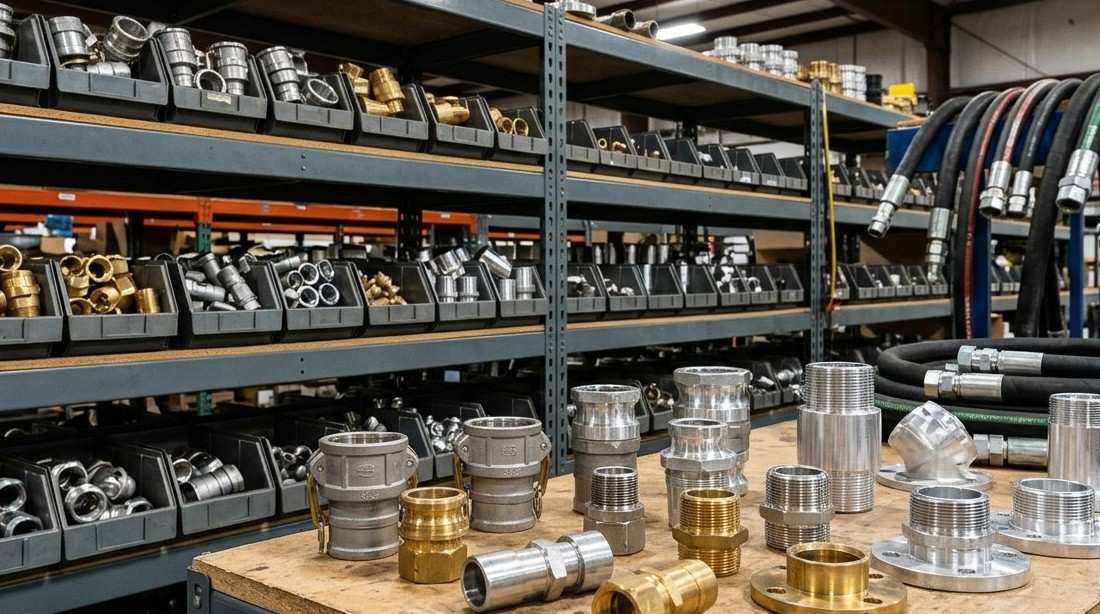
7 Factors to Consider When Buying Industrial Hose Fittings
Choosing the right industrial hose fitting affects how a fluid system performs over its entire service life. A fitting that is mismatched to the working pressure, media, or thread standard often leads to leaks, premature wear, or unplanned downtime long before the hose itself wears out.
Engineers, procurement teams, and maintenance managers who understand what actually separates a reliable fitting from a poor one can avoid most of these problems before installation even begins. This guide breaks down the practical factors that matter most when buying industrial hose fittings for hydraulic, pneumatic, or fluid transfer systems.
Material Selection And Corrosion Resistance
The base material of a fitting determines how well it holds up against the fluid it carries and the environment it sits in. Carbon steel suits general hydraulic circuits due to its strength and cost efficiency, brass works well in lower pressure air and water lines, and stainless steel is preferred for chemical, marine, food, and pharmaceutical use where corrosion resistance matters most.
Surface treatment also plays a role. Zinc or zinc nickel plating protects carbon and alloy steel fittings, while stainless steel relies on its natural chromium content instead of a coating. Fittings used in exposed marine or offshore environments face similar corrosion challenges to those covered in this overview of storm valves in marine industries.
Pressure Rating And Working Conditions
Every fitting is built around a working pressure range that should sit comfortably above the system’s actual operating pressure, leaving room for occasional spikes. A frequent mistake is confusing working pressure with burst pressure.
Working pressure is the level a fitting is designed to handle continuously, while burst pressure is the point of mechanical failure under test conditions. The two numbers should never be used interchangeably when planning a system.
| Material | Typical Working Pressure |
|---|---|
| Brass | Up to 2500 psi |
| Carbon Steel | Up to 3000 psi |
| Plated Steel | Up to 4000 psi |
| Stainless Steel | Up to 6000 psi |
| Alloy Steel | Up to 10000 psi |
These figures are general references, and actual ratings vary by fitting size and design, so checking the manufacturer’s documented pressure range for each product series is a more reliable approach than assuming values based on similar looking parts. Systems that also rely on pressure relief components can benefit from reviewing these safety valve insights for UAE industrial processes to understand how pressure management extends across a full piping system.
Size And Thread Type Compatibility
Correct sizing begins with matching the fitting bore to the hose inside diameter, then confirming the thread form matches the mating port on the pump, valve, or cylinder. Common thread standards include NPT, BSP, JIC, ORFS, and metric threads, each with its own sealing approach and regional prevalence.
Reading a fitting correctly means checking the outer thread diameter and pitch against a reference chart before ordering a replacement, since a mismatch here is one of the most common causes of cross threading and early leak points. For fittings that connect at odd angles or split flow between lines, this guide on elbow pipe fittings types and applications explains how directional fittings are sized and selected for real world piping layouts.
Connection Style And Sealing Method
The physical layout of a fitting affects installation ease and long term reliability. Straight fittings give a direct inline connection, elbows redirect flow in tight spaces, tees split or combine flow, adapters bridge different thread types, and couplings allow quick disconnection in lines serviced often.
The sealing method matters just as much as the shape. O ring, tapered thread, flare, and gasket seals each respond differently to vibration and thermal cycling, and a face seal design generally outperforms a tapered thread seal in circuits with frequent movement. Systems using grooved connections for quick assembly can benefit from reviewing this guide on grooved pipe fittings types and installation.
Temperature Range And Media Compatibility
Temperature affects both the fitting body and the seal material inside it. Hydraulic oil circuits, compressed air lines, and chemical transfer systems each present different combinations of ambient and internal media temperature, and the seal chosen should tolerate both extremes the application is likely to face.
| Seal Material | Approximate Temperature Range | Common Use |
|---|---|---|
| Nitrile | -40°F to 250°F | General hydraulic oil and water-based fluids |
| Fluorocarbon | -15°F to 400°F | Higher heat and chemical-resistant applications |
| PTFE | -100°F to 500°F | Wide chemical resistance and broad temperature range |
Media compatibility extends beyond temperature alone. Certain hydraulic fluids and cleaning chemicals interact with elastomers over time, causing the seal to swell or harden well before the fitting body shows visible wear, which is why seal material deserves the same scrutiny as the metal fitting itself.
Manufacturing Quality And Installation Practice
Manufacturing method influences how consistently a fitting performs under repeated pressure cycling. Forged fittings generally have a denser internal grain structure than cast fittings, supporting more even stress distribution around the thread and sealing surfaces.
Surface finish quality, including consistent plating thickness and smooth sealing faces, also affects corrosion resistance and how well the fitting maintains a tight seal across repeated assembly cycles. Correct installation practice matters just as much as the fitting itself, since even a well made part can fail early if assembled incorrectly.
Reviewing established guidance such as these best practices for threadolet fitting installation offers a useful reference for the kind of care that extends service life across threaded and branch connections alike.
Availability And Delivery Timelines
A fitting that meets every technical requirement is still a problem if it cannot be sourced when a project needs it. Lead time becomes especially important for facilities that run continuous operations, where a single missing fitting can hold up an entire maintenance window or installation schedule.
Buyers should confirm stock availability, minimum order quantities, and typical delivery timelines before committing a project schedule to a specific fitting configuration. Suppliers who carry consistent inventory across common sizes and thread types reduce the risk of last minute substitutions that were not part of the original design.
Supplier Reliability And Support
Even a well specified fitting depends on consistent production quality to perform as expected. Working with a supplier that maintains stable dimensional tolerances across production batches reduces the risk of fit issues when components from different orders are installed together, which matters most in facilities that source and maintain equipment over many years.
Custom requirements are common in industrial settings, particularly where equipment uses non standard port sizes or unusual routing geometry. A supplier able to adjust bend angles, thread combinations, or overall length gives engineering teams more flexibility than working from fixed catalog sizes alone.
Buyers comparing hose and fitting assemblies for hydraulic or pneumatic systems can browse a full range through this Industrial Hoses Supplier to match products against project specifications before ordering.
Conclusion
Selecting the right industrial hose fitting comes down to matching material, pressure rating, thread type, sealing method, temperature range, manufacturing quality, availability, and supplier reliability to the actual working environment. Getting each of these factors right reduces leaks, premature wear, and unplanned downtime across hydraulic and fluid transfer systems.
FW Trading LLC stocks a wide range of industrial hose fittings built for demanding hydraulic and fluid transfer applications across Dubai, the UAE, and the GCC.
Ready to get started? Reach out to our team today for technical advice or a fast quote.
Expert Guides on Industrial Insights
If you want to deepen your understanding of industrial fittings, piping systems, and engineering best practices, explore these related articles:
- Which High Pressure Valves Are Best for Oil and Gas – Choosing the right high pressure valves for safe and efficient operations.
- Buttweld vs Threaded Fittings: Which Is Better for Piping – A side by side comparison of welded and threaded pipe connections.
- Rigid vs Flexible Grooved Couplings – A guide to choosing the right coupling type for fire protection, HVAC, and industrial piping.
- Why Grooved Fittings Are a Smart Choice for Piping Systems – The advantages of grooved fittings in modern piping networks.
- I Tested CS vs SS Buttweld Fittings for 30 Days – Hands on results comparing corrosion, strength, and maintenance between carbon steel and stainless steel fittings.
Popular Posts
March 22, 2024
March 28, 2024
April 22, 2024
April 30, 2024
