Pressure gauges are essential instruments in industrial systems, HVAC networks, hydraulic equipment, compressors, pipelines, and manufacturing plants. Choosing the correct pressure gauge directly affects operational accuracy, equipment life, and maintenance costs.
One of the most common comparisons in industrial instrumentation is between glycerin filled pressure gauges and dry pressure gauges. While both perform the same core function of measuring pressure, they behave very differently under real working conditions.
Understanding Pressure Gauges
A pressure gauge measures the force exerted by gases or liquids within a system. Most industrial gauges use a Bourdon tube mechanism that converts pressure into mechanical movement, causing the needle to display readings on the dial.
Industries looking for reliable and accurate monitoring solutions often prefer high quality pressure gauges (glycerine filled & dry) designed for long term industrial performance.
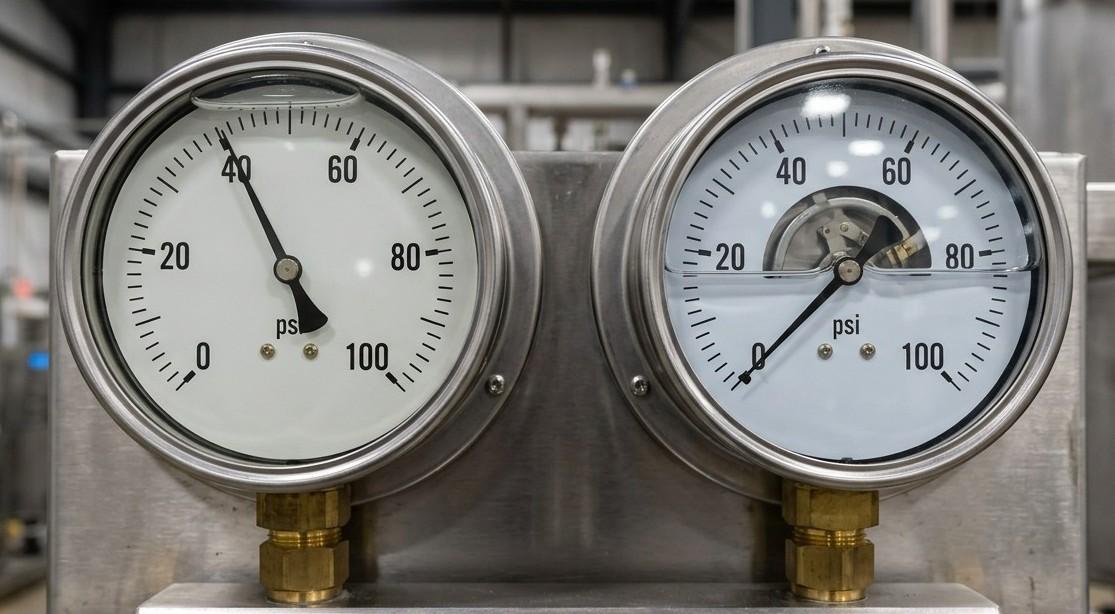
The key difference lies in the internal case construction:
- Dry pressure gauges contain only air inside the casing
- Glycerin filled gauges contain liquid glycerin surrounding the internal mechanism
This single design difference significantly impacts durability, readability, and performance.
What Is a Glycerin Filled Pressure Gauge?
A glycerin filled pressure gauge contains glycerin liquid inside the casing to dampen vibrations and stabilize needle movement. The liquid acts as a cushion that protects internal mechanical components from shock and pulsation.
Key Characteristics
- Vibration Resistance: The glycerin reduces pointer flutter caused by pumps, compressors, or hydraulic systems.
- Improved Readability: The needle remains stable even under fluctuating pressure conditions.
- Corrosion Protection: The liquid helps prevent moisture entry and internal corrosion.
- Longer Service Life: Reduced mechanical stress extends calibration stability and operating lifespan.
What Is a Dry Pressure Gauge?
A dry pressure gauge contains no liquid fill. The internal components operate in an air filled environment, allowing faster needle response.
Key Characteristics
- Faster Response: The needle reacts immediately to pressure changes.
- Lower Cost: Dry gauges are generally cheaper and easier to replace.
- Lightweight Construction: Without liquid filling, the gauge weighs less.
- Better for Stable Systems: Ideal for low vibration environments such as laboratory systems or indoor panels.
Key Differences Between Glycerin and Dry Pressure Gauges
Construction and Internal Design
Glycerin Filled Pressure Gauge
- Filled with glycerin liquid
- Sealed casing design
- Dampened internal movement
Dry Pressure Gauge
- Air filled casing
- Simpler construction
- Direct mechanical movement
Vibration Resistance
Glycerin Filled Gauge
Glycerin filled gauges are specifically designed for environments with heavy vibration and pulsation. The liquid absorbs mechanical shock and stabilizes the needle.
Dry Gauge
Dry gauges are more vulnerable to vibration damage and pointer fluctuation in industrial systems.
Needle Stability and Readability
Glycerin Filled Gauge
The needle movement remains smooth and stable, making readings easier to monitor during machine operation.
Dry Gauge
The pointer may bounce or flutter under fluctuating pressure conditions, reducing readability.
Durability and Lifespan
Glycerin Filled Gauge
The internal liquid protects components from wear, extending the gauge lifespan in harsh environments.
Dry Gauge
Dry gauges may wear out faster when exposed to vibration or pressure spikes.
Temperature Performance
Glycerin Filled Gauge
Glycerin may thicken in extremely cold temperatures, which can slow needle movement.
Best Operating Conditions
- Moderate industrial temperatures
- Outdoor systems with vibration
- Heavy duty equipment
Dry Gauge
Dry gauges are better suited for extremely cold or high temperature environments where liquid viscosity could become an issue.
Best Operating Conditions
- Cold storage systems
- Indoor installations
- Stable process systems
Maintenance Requirements
Glycerin Filled Gauge
- Requires less maintenance in vibrating environments
- Better resistance to moisture and contamination
- May require replacement if leakage occurs
Dry Gauge
- Easier and cheaper to replace
- Requires more frequent replacement in harsh environments
Cost Comparison
Glycerin Filled Gauge
- Higher initial cost
- Better long term value in industrial operations
Dry Gauge
- Lower purchase price
- Cost effective for standard applications
Glycerin vs Dry Pressure Gauges Comparison Table
| Feature | Glycerin Filled Gauge | Dry Pressure Gauge |
|---|---|---|
| Vibration Resistance | Excellent | Limited |
| Reading Stability | High | Moderate |
| Durability | Long lifespan | Lower lifespan |
| Moisture Protection | Better protection | Limited protection |
| Maintenance | Moderate | Simple |
| Cost | Higher | Lower |
| Industrial Suitability | Heavy duty applications | Basic applications |
Industrial Applications of Glycerin Filled Gauges
Hydraulic Systems
Hydraulic machinery generates constant pressure pulsation and vibration. Glycerin filled gauges help maintain stable readings and reduce internal damage.
Oil and Gas Industry
Oilfield systems often operate under extreme pressure conditions where accurate monitoring is critical for safety and performance.
Marine Applications
Marine environments expose gauges to vibration, humidity, and salt air. Glycerin filled gauges perform better under these conditions.
Manufacturing Plants
Heavy industrial equipment generates continuous vibration that can quickly damage dry gauges.
Industrial Applications of Dry Pressure Gauges
Residential Water Systems
Dry gauges are commonly installed in household plumbing systems where pressure conditions remain relatively stable.
HVAC Systems
Basic air conditioning and ventilation systems often use dry gauges for routine pressure monitoring.
Low Vibration Equipment
Dry gauges work effectively in stationary systems with minimal mechanical movement.
Expert Insight: Which Gauge Performs Better?
Industrial instrumentation specialists generally recommend glycerin filled gauges for demanding industrial environments because they offer:
- Higher durability
- Better readability
- Improved vibration resistance
- Reduced maintenance frequency
However, experts also note that dry gauges remain a practical option for controlled environments where vibration and pulsation are minimal.
The best choice depends entirely on operating conditions rather than price alone.
Factors to Consider Before Choosing a Pressure Gauge
Operating Environment
Evaluate vibration levels, pressure pulsation, humidity, and exposure conditions.
Pressure Range
Select a gauge with the appropriate operating range for system pressure.
Temperature Conditions
Extreme temperatures may influence liquid filled gauge performance.
Installation Location
Outdoor and marine installations generally benefit from glycerin filled protection.
Maintenance Requirements
Consider accessibility and long term maintenance costs before selecting gauge types.
Future Trends in Industrial Pressure Monitoring
Modern industrial systems increasingly integrate advanced pressure monitoring technologies including:
- Digital pressure gauges
- Remote pressure monitoring
- Smart sensor integration
- IoT enabled instrumentation
Despite these innovations, traditional mechanical glycerin filled gauges remain widely used because of their simplicity, reliability, and durability in harsh industrial environments.
Conclusion
Both glycerin filled and dry pressure gauges are designed for different operating conditions. Glycerin filled gauges are best for vibrating and harsh industrial environments, while dry gauges are ideal for stable and cost sensitive applications. Choosing the right pressure gauge improves accuracy, equipment protection, and long term system reliability.
Need Reliable Pressure Gauge Solutions?
For businesses looking for high quality glycerin filled and dry pressure gauges for industrial, marine, hydraulic, and commercial applications, Fitting World Trading LLC provides reliable pressure measurement solutions designed for durability, accuracy, and long term performance.
Contact our pressure gauge experts for reliable pressure measurement solutions designed for long term industrial performance and operational accuracy.
Expert Guides on Pipes, Fittings & Industrial Solutions
Discover guides on carbon & stainless steel pipes, flanges, fittings, and high-pressure products for your next project.
- Top 5 Benefits of Camlock Fittings for Industrial Applications: Improve fluid transfer efficiency, safety, and maintenance speed.
- How to Choose Buttweld Fittings for UAE Construction Projects: Expert Tips for Selecting Durable Buttweld Fittings in UAE Construction.
- Grooved Pipe Fittings for Fire Protection Systems in UAE: Reliable and durable grooved pipe fittings for efficient UAE fire protection systems.
- Which High Pressure Valves Are Best for Oil and Gas: Choosing the right high-pressure valves for safe and efficient oil and gas operations.
- Advantages of Grooved Fittings in Piping Systems: Enhance efficiency and reliability in your piping systems with grooved fittings.