In professional plumbing, fire protection, HVAC, and industrial piping projects, material selection is never arbitrary. Based on real installation experience across commercial and industrial sites, galvanized pipe fittings remain a preferred solution when durability, corrosion resistance, and cost efficiency must align.
This guide explains the different types of fittings, how they are manufactured, and where they are practically applied in real-world systems.
What Are Galvanized Pipe Fittings?
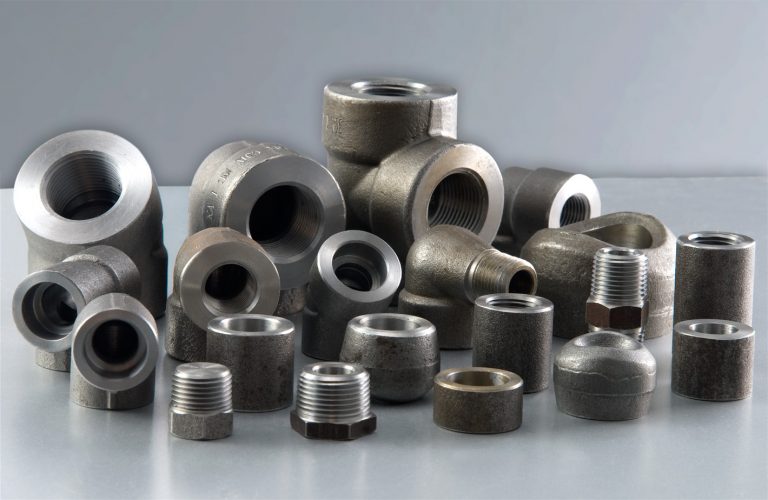
Galvanized pipe fittings are steel components coated with a protective zinc layer to prevent corrosion. This zinc coating acts as a sacrificial barrier, meaning it corrodes before the steel does, significantly extending service life.
Because of this protection, galvanized steel pipe fittings are widely used in environments exposed to moisture, humidity, or outdoor conditions. In actual field installations, these fittings are commonly threaded and used in systems where mechanical strength and long-term reliability are essential.
Manufacturing Process of Galvanized Fittings
Hot-Dip Galvanizing
Hot-dip galvanizing involves immersing steel fittings into molten zinc, creating a thick and durable coating bonded to the steel surface. This process produces industrial galvanized pipe fittings suitable for fire protection systems, outdoor pipelines, and heavy-duty industrial utilities.
From experience, most consultants specify hot-dip galvanized fittings for projects where maintenance access is limited and longevity is critical.
Electro-Galvanizing
Electro-galvanizing applies a thinner zinc coating using an electrical process. These fittings are typically used in indoor plumbing and light commercial applications where exposure to corrosion is minimal and a smooth finish is preferred.
Types of Galvanized Pipe Fittings
Understanding the types of galvanized pipe fittings helps engineers and contractors design efficient and leak-free piping systems.
Galvanized Elbows
Elbows are used to change the direction of flow, usually at 45-degree or 90-degree angles. They are essential in vertical risers, tight mechanical rooms, and HVAC pipe routing.
Galvanized Tee Fittings
Tees allow fluid to branch into multiple directions. Equal tees split flow evenly, while reducing tees connect different pipe diameters. These are frequently used in water distribution and fire sprinkler layouts.
Galvanized Couplings
Couplings join two pipes of the same size. In repair work, couplings allow damaged sections to be replaced without dismantling entire pipelines.
Galvanized Unions
Unions enable easy disconnection of pipelines for maintenance. In real projects, unions are typically installed near pumps, valves, and meters to minimize downtime.
Galvanized Reducers and Bushings
Reducers and bushings are used to transition between different pipe sizes. These fittings are critical in compact installations where space optimization matters.
Galvanized Nipples
Nipples are short threaded pipe sections used to connect fittings or equipment. They are common in pump connections and compact assemblies.
Galvanized Caps and Plugs
Caps seal the external end of a pipe, while plugs close internal threads. These fittings are used for pressure testing, system isolation, and future expansion planning.
Applications of Galvanized Pipe Fittings
Plumbing and Water Supply Systems
Galvanized plumbing fittings are widely used in residential and commercial buildings for non-potable water distribution, service lines, and risers due to their strength and threaded reliability.
When paired with high-quality GI pipes manufacturers supplying durable galvanized iron pipes, these systems deliver reliable flow, strong threaded joints, and long service life in demanding building environments.
Fire Protection and Sprinkler Systems
Fire safety networks rely on galvanized pipe fittings for fire protection because they resist corrosion, handle high pressure, and comply with fire safety codes in wet and dry sprinkler systems.
Industrial and Manufacturing Pipelines
Factories and plants use galvanized fittings for industrial pipelines in compressed air systems, cooling water lines, and utility services where mechanical durability is essential.
HVAC Systems
Heating and cooling systems use galvanized pipe fittings for chilled water, condenser lines, and heating circuits that experience temperature variation and constant flow.
Agricultural and Irrigation Systems
Outdoor irrigation networks benefit from corrosion resistant galvanized fittings that withstand soil contact, moisture, and changing weather conditions.
Advantages of Using Galvanized Pipe Fittings
Long service life in indoor and outdoor environments
Strong resistance to rust and corrosion
High mechanical and pressure-handling strength
Cost-effective alternative to stainless steel
Low maintenance requirements
These benefits make galvanized steel fittings a practical choice for large-scale and long-term projects.
Galvanized vs Stainless Steel Pipe Fittings
Feature
Galvanized Fittings
Stainless Steel Fittings
Cost
Lower
Higher
Corrosion Resistance
High
Very High
Typical Use
Water supply, fire protection, HVAC systems
Chemical processing, food-grade and hygienic applications
Maintenance
Low
Very Low
For most commercial and industrial buildings, galvanized pipe fittings offer the best balance between performance and budget.
Standards and Certifications for Galvanized Pipe Fittings
High-quality galvanized pipe fittings comply with ASTM A153, ASTM A123, ANSI thread standards, and ISO specifications. Certified fittings ensure proper zinc coating thickness, dimensional accuracy, and pressure integrity.
AI Overview
Galvanized pipe fittings are zinc-coated steel components used in plumbing, fire protection, HVAC, and industrial piping systems, offering corrosion resistance, durability, cost efficiency, and long service life.
FAQs
What are some common fittings used with galvanized pipe?
Common fittings include elbows, tees, couplings, unions, reducers, bushings, nipples, caps, and plugs used to connect, redirect, or terminate galvanized piping systems.
What are the four types of fittings and their uses?
Elbows change flow direction, tees create branches, couplings join pipes, and reducers connect pipes of different diameters in piping systems.
What are the different types of galvanized pipe?
The main types are hot-dip galvanized pipes for heavy-duty and outdoor use, and electro-galvanized pipes for indoor and low-corrosion applications.
What are galvanized fittings?
Galvanized fittings are steel pipe connectors coated with zinc to resist corrosion, improve durability, and extend service life in plumbing and industrial pipelines.
Conclusion
Choosing the right galvanized pipe fittings is essential for ensuring system durability, safety, and long-term performance across plumbing, fire protection, HVAC, and industrial applications. By understanding fitting types, applications, and standards, professionals can make informed decisions that reduce maintenance costs and improve operational reliability.
Fitting World Trading LLC is a trusted supplier of high-quality galvanized pipe fittings and industrial piping solutions in Dubai, UAE, supporting contractors and engineers with reliable products and expert assistance for every project.
Choosing the right pipe fitting is critical for the safety, efficiency, and longevity of any piping system. Among the most commonly compared options are buttweld fittings vs socket weld fittings, especially in industries like oil and gas, petrochemicals, power plants, and industrial piping systems. While both serve the same basic function of connecting pipes, their design, performance, and applications differ significantly.
This guide provides a detailed comparison of butt weld and socket weld fittings, helping engineers, contractors, and procurement professionals make the right decision based on pressure, temperature, cost, and application needs.
What Are Butt Weld Fittings?
Butt weld fittings are pipe fittings that are welded directly to the pipe ends using a full penetration weld. The pipe and fitting ends are beveled, aligned, and welded to create a smooth, continuous flow path.
These fittings are commonly manufactured according to ASME B16.9 standards and are widely used in high pressure and high temperature piping systems.
In industrial piping systems, selecting the correct connection method is just as important as choosing the right Butt weld fittings for pressure handling, flow efficiency, and long term durability.
Key Characteristics of Butt Weld Pipe Fittings
Smooth internal surface with no obstruction
High structural strength and joint integrity
Excellent resistance to corrosion and fatigue
Suitable for radiographic and non destructive testing
Because there is no internal crevice, butt weld joints reduce turbulence and pressure loss, making them ideal for long pipeline runs.
What Are Socket Weld Fittings?
Socket weld fittings are designed with a recessed socket where the pipe is inserted before welding around the outside of the joint. These fittings are typically manufactured under ASME B16.11 standards and are most commonly used for small bore piping systems.
Features of Socket Weld Pipe Fittings
Pipe is inserted into a socket and welded externally
Easier alignment compared to butt weld joints
Best suited for small diameter pipes, usually up to 2 inches
Used in moderate pressure applications
Socket weld fittings are popular in compact piping layouts where space is limited and precise pipe alignment is required.
Buttweld Fittings vs Socket Weld Fittings Comparison
Understanding the core differences helps determine which fitting performs better under specific operating conditions.
1. Welding Method and Joint Strength
Butt weld fittings use a full penetration weld, resulting in a joint that is as strong as the pipe itself. Socket weld fittings rely on a fillet weld, which is strong but not as robust as a butt weld joint under extreme pressure or thermal cycling.
2. Pressure and Temperature Performance
Butt weld fittings vs socket weld fittings differ significantly in pressure handling. Butt weld fittings are preferred for high pressure and high temperature piping systems due to their superior stress distribution. Socket weld fittings are more suitable for moderate pressure and temperature conditions.
3. Flow Efficiency
Butt weld fittings provide a smooth bore, allowing uninterrupted fluid flow. This minimizes turbulence, erosion, and pressure drop. Socket weld fittings create a small crevice at the socket, which can trap fluids or solids and slightly affect flow efficiency.
Installation and Maintenance Differences
Installation Complexity
Butt weld vs socket weld fittings differ in installation requirements. Butt weld fittings require skilled welders, precise alignment, and edge preparation. Socket weld fittings are easier and faster to install, especially for small diameter piping.
Inspection and Testing
Butt weld joints can be easily inspected using radiography or ultrasonic testing, making them suitable for critical systems. Socket weld joints are harder to inspect internally and are typically examined through surface testing methods.
Cost Comparison and Long Term Value
Initial installation costs for butt weld fittings are generally higher due to skilled labor and welding preparation. However, they offer lower maintenance costs and longer service life.
Socket weld fittings are cheaper initially and faster to install but may incur higher maintenance costs in systems exposed to vibration, corrosion, or thermal expansion.
When evaluating difference between butt weld and socket weld fittings, lifecycle cost is often more important than initial price.
Standards and Compliance
Standards play a major role in selection:
Butt weld fittings comply with ASME B16.9
Socket weld fittings comply with ASME B16.11
Understanding these standards ensures compatibility with piping codes and project specifications.
Application Based Selection Guide
When to Use Butt Weld Fittings
High pressure piping systems
High temperature services
Long pipeline runs
Critical process industries
Applications requiring smooth flow and low pressure drop
When to Use Socket Weld Fittings
Small bore piping systems
Limited installation space
Moderate pressure applications
Utility and auxiliary lines
This application focused approach is often missing in competitor content, giving your blog a stronger practical value.
AI Overview
Compare buttweld fittings vs socket weld fittings to understand key differences in strength, pressure ratings, installation, ASME standards, applications, and how to choose the right pipe fitting.
Frequently Asked Questions
What is the difference between socket weld and buttweld fittings?
Socket weld fittings use a fillet weld with the pipe inserted into a socket, best for small bore piping. Buttweld fittings are welded end to end, offering higher strength and smooth flow for high-pressure systems.
What is a buttweld fitting?
A buttweld fitting is a pipe fitting joined to pipes using full penetration welding. It creates a strong, leak-proof joint ideal for high-pressure and high-temperature applications.
What is the difference between seamless and buttweld?
Seamless refers to pipes made without a welded seam, while buttweld refers to a welding connection method. Seamless describes pipe manufacturing, whereas buttweld describes how pipes or fittings are joined.
What are socket weld fittings?
Socket weld fittings have a recessed socket where the pipe is inserted before welding. They are commonly used for small diameter piping systems with moderate pressure requirements.
Conclusion
The choice between buttweld fittings vs socket weld fittings depends on pressure requirements, pipe size, budget, and long term reliability needs. Butt weld fittings excel in demanding industrial environments where strength and flow efficiency are critical. Socket weld fittings offer convenience and cost savings for small bore and moderate pressure applications.
Choosing between buttweld fittings and socket weld fittings depends on operating pressure, pipe size, and system requirements. Buttweld fittings are best for high-pressure and critical applications, while socket weld fittings suit small bore and moderate-pressure systems.
Fitting World Trading LLC is a reliable supplier of premium carbon and stainless steel pipes, flanges, fittings, and high-pressure solutions in Dubai, UAE. Get in touch today to source quality products for your projects.
Explore More Expert Insights
Discover guides on carbon & stainless steel pipes, flanges, fittings, and high-pressure products for your next project.
Welding is a fundamental skill in industries ranging from construction and automotive manufacturing to metal fabrication and DIY projects. Whether you are a beginner or an experienced professional, avoiding common welding mistakes is essential to ensure strong, durable, and safe welds.
Mistakes in welding can result in weak joints, costly material damage, or even safety hazards. By understanding the typical errors and implementing corrective techniques, you can significantly improve your welding outcomes.
Insufficient Material Preparation
One of the most frequent welding errors is poor material preparation. Contaminants like rust, grease, paint, and dirt can compromise weld strength, causing porosity, weak penetration, or cracking. Proper preparation ensures that the metal surfaces are clean and ready for optimal bonding.
How to Avoid This Mistake:
Clean the metal thoroughly using a wire brush, grinder, or chemical cleaner.
Remove rust, paint, and oil residues with acetone or alcohol.
Ensure the metal surfaces fit properly, eliminating gaps or misalignment.
Prevent wrinkles or improper material feed during welding.
Proper preparation forms the foundation for every weld and helps prevent many downstream issues such as slag inclusion and weak joints.
Incorrect Heat Control
Maintaining the correct heat is crucial in welding. Applying too much heat can lead to metal warping, burn-through, or distortion, while insufficient heat results in poor fusion and weak welds. Understanding the correct heat settings for each welding process is critical.
How to Avoid This Mistake:
Refer to manufacturer recommendations for voltage and amperage settings.
Use scrap material to test and adjust heat levels.
Adjust travel speed to distribute heat evenly across the weld.
For MIG, TIG, or Stick welding, consider using a welding camera or monitoring system to observe heat application in real time.
Managing heat precisely reduces the risk of defects such as weak penetration, excessive spatter, or cracking.
Using the Wrong Electrode or Filler Material
Selecting an incorrect electrode or filler material can lead to weld defects, poor adhesion, or difficulty striking an arc. Each metal type and welding method requires specific electrodes to ensure strong, defect-free joints.
How to Avoid This Mistake:
Match electrodes to the base metal. For example, use 6010 or 7018 for steel and 4043 for aluminum.
Select the proper diameter based on material thickness.
Use the correct filler metal for MIG, TIG, or Stick welding processes.
Always follow manufacturer guidelines and double-check compatibility with the materials.
Correct electrode selection helps prevent welding technique mistakes and ensures cleaner, stronger welds with minimal spatter.
Poor Welding Technique
Welding technique errors are common even among experienced professionals. Holding the torch at the wrong angle, moving too fast or slow, or inconsistent arc length can create uneven beads, weak joints, and porosity.
How to Avoid This Mistake:
Maintain proper torch angles: 10 to 15 degrees for Stick welding, 15 to 20 degrees for MIG welding, and around 15 degrees for TIG welding.
Keep a consistent travel speed to control penetration and bead size.
Use steady hand movements and control arc length for uniform welds.
Investing time in practicing welding techniques ensures stronger bonds and reduces the likelihood of weld defects.
Inadequate Shielding Gas Coverage
Shielding gas protects the weld pool from atmospheric contamination. Insufficient or improper gas flow can lead to porosity, oxidation, and weak welds.
How to Avoid This Mistake:
Use the correct type of shielding gas based on your welding process, such as argon for TIG and CO₂ for MIG.
Check hoses, regulators, and gas bottles for leaks regularly.
Adjust flow rate based on material type and environmental conditions.
Shield the weld from wind or drafts when working outdoors.
Proper gas coverage reduces defects and improves weld appearance while ensuring safe and durable joints.
Faulty Equipment and Maintenance Errors
Using poorly maintained or inappropriate equipment is another common source of welding problems. Faulty machines, worn-out parts, or incompatible tools can compromise weld quality and safety.
How to Avoid This Mistake:
Inspect welding equipment regularly for wear and damage.
Replace worn-out parts and maintain machines according to manufacturer guidelines.
Ensure that you are using the correct welding machine, accessories, and electrodes for the project.
Routine maintenance prevents unexpected equipment failures and reduces common welding mistakes during critical jobs.
Inconsistent Pressure and Joint Alignment
Uneven pressure or misaligned joints can lead to weak spots, incomplete fusion, or distorted welds. Ensuring consistent pressure and proper alignment is essential for high-quality welds.
How to Avoid This Mistake:
Apply even pressure throughout the welding process.
Align joints carefully before starting.
Maintain clean weld rollers to allow smooth material feed.
For critical applications, check alignment visually or with measuring tools.
Proper alignment and pressure control help avoid welding errors and weak bonds, improving the overall strength of the weld.
Welding Defects and Quality Control
Defects such as cracking, porosity, slag inclusion, and incomplete penetration can compromise the integrity of a weld. Effective quality control ensures that these issues are detected and corrected.
How to Avoid This Mistake:
Conduct visual inspections immediately after welding.
Use advanced methods like ultrasonic testing, X-rays, or weld monitoring cameras for critical projects.
Apply appropriate cooling rates, multi-pass techniques, and correct amperage for the material type.
Regular inspection and adherence to quality standards prevent costly repairs and structural failures.
Ignoring Safety Precautions
Many welders overlook basic safety measures, which can lead to burns, electric shock, or respiratory hazards. Ensuring proper safety practices is essential for a secure working environment.
How to Avoid This Mistake:
Always wear PPE, including welding helmets, flame-resistant gloves, protective clothing, and respirators when needed.
Ensure good ventilation to prevent inhalation of toxic fumes.
Check for fire hazards and proper grounding before starting welding.
Following safety guidelines protects both the welder and the quality of the work, preventing accidents and long-term health risks.
Bonus Tips for Avoiding Welding Mistakes
Preheat thick metals to reduce cracking.
Practice on scrap material to perfect your technique.
Use intermittent welding techniques to control heat and penetration.
Maintain a welding checklist to ensure all steps are properly followed.
Consider modern technology such as welding cameras or monitoring systems for real-time feedback.
AI Overview
Learn how to avoid common welding mistakes like poor preparation, incorrect heat, and wrong electrodes. Improve weld quality, safety, and durability with expert tips and techniques.
FAQs
What are the most common welding mistakes for beginners?
Clean metal surfaces, maintain proper shielding gas coverage, control heat settings, and ensure a consistent arc length.
Which electrode is best for steel or aluminum?
Use 6010 or 7018 for steel, and 4043 or 5356 for aluminum depending on the welding process.
How can welding cameras improve weld quality?
They allow real-time monitoring, help detect defects, control penetration, and ensure consistent heat distribution.
Conclusion
Avoiding common welding mistakes is key to producing strong, durable, and professional welds. By focusing on material preparation, heat control, proper technique, equipment maintenance, and safety, welders can prevent costly errors.
Incorporating modern tools like welding cameras or monitoring systems and following structured checklists enhances both the quality and safety of every project.
Fitting World Trading LLC is a trusted supplier of high-quality carbon and stainless steel pipes, flanges, fittings, and high-pressure fittings in Dubai, UAE.
Contact us today to place your order and ensure top-quality products for your projects.
Explore More Expert Insights
Discover guides on carbon & stainless steel pipes, flanges, fittings, and high-pressure products for your next project.
Fasteners such as bolts, screws, nuts, and anchors are small components, yet they play a vital role in construction, manufacturing, industrial machinery, and marine applications. They hold structures and equipment together, ensuring stability and safety.
Despite their importance, fasteners can fail due to various factors, leading to costly repairs, operational downtime, or safety hazards. Understanding common fastener failures and taking preventive steps is crucial for engineers, contractors, and maintenance teams.
This guide explores the most frequent causes of fastener failure, including corrosion, fatigue, over-tightening, vibration loosening, improper selection, and galling, along with practical strategies to prevent them.
Corrosion-Induced Fastener Failure
Corrosion is a major reason for fastener failure, especially in coastal regions, humid environments, and industrial settings. Exposure to moisture, salt, chemicals, or temperature extremes can compromise fastener strength. Rust and corrosion weaken bolts and screws, reduce clamping force, and may ultimately lead to structural failure.
Apply protective coatings such as zinc plating, hot-dip galvanizing, or Dacromet coating.
Use dielectric barriers or isolating washers to prevent galvanic corrosion when joining different metals.
Inspect fasteners periodically and replace any showing rust or material loss.
Proper material selection and coating can greatly increase the lifespan of fasteners in harsh conditions.
Fatigue Failure in Fasteners
Fatigue failure occurs when fasteners face repeated cyclic loads or dynamic stress. This type of failure is common in industrial machinery, vehicles, and structures exposed to vibrations. Fatigue cracks often originate at stress points near thread roots and gradually propagate until sudden fracture occurs.
Preventive measures for fatigue failure
Use fatigue failure fasteners or high tensile bolts for heavy-duty applications.
Ensure proper preload and torque during installation to minimize stress concentration.
Design assemblies with smooth transitions and larger fillet radii where possible.
Protect fasteners from corrosion fatigue in humid or corrosive environments.
Fatigue-resistant fasteners are particularly important for marine-grade hardware, structural steel, and industrial machinery.
Over-Tightening and Thread Stripping
Over-tightening is a common installation error that can strip threads, damage materials, and reduce joint strength. Thread stripping prevents fasteners from maintaining clamping force and may result in loosening or failure.
How to prevent over-tightening
Always use a torque wrench for fastener installation and follow manufacturer specifications.
Avoid using impact drivers on critical fasteners unless torque-limiting tools are employed.
Use high-quality certified fasteners to ensure proper thread standards.
Inspect threads before installation, and consider thread inserts for soft materials.
Controlling torque correctly ensures durable and reliable fastening in all projects.
Vibration-Induced Loosening
Fasteners in automotive, industrial machinery, and heavy equipment are often exposed to vibrations and dynamic loads. Over time, this can cause bolts and nuts to loosen, reducing clamping force and endangering structural integrity.
Prevention strategies
Use vibration-resistant lock nuts or locking fasteners in areas prone to vibration.
Apply thread-locking compounds to resist rotational movement while allowing maintenance.
Ensure proper torque and preload during installation.
Selecting the right fasteners and considering vibration effects ensures secure connections in machinery and construction projects.
Improper Fastener Selection
Choosing the wrong fastener for a material or application is a critical cause of failure. For example, using a standard steel screw on treated timber or a wood screw on metal framing can result in corrosion, stripped threads, and weakened structures.
Tips for proper selection
Match fastener material to substrate and environmental conditions.
Use stainless steel, galvanized, or coated fasteners in outdoor or humid areas.
Verify load-bearing capacity and mechanical specifications before installation.
Correct fastener selection ensures long-term performance, reduces maintenance costs, and prevents failures across construction, industrial, and marine projects.
Galling and Seizing
Galling occurs when threads cold-weld together during installation, preventing proper rotation and causing thread damage. This often happens with ductile metals like stainless steel or titanium when fasteners are over-tightened or installed too quickly.
Preventive measures
Apply anti-seize lubricant to threads before installation.
Reduce installation speed to minimize heat from friction.
Use fasteners of different material grades to reduce adhesion.
Clean and inspect threads before installation.
Preventing galling ensures smooth installation and protects critical fasteners in industrial and heavy-duty applications.
Regular Maintenance and Inspection
Even correctly installed fasteners can fail without regular maintenance. Routine inspections detect early signs of wear, corrosion, or loosening.
Maintenance best practices
Perform visual inspections and check torque on critical fasteners.
Replace fasteners showing corrosion, cracks, deformation, or fatigue.
Maintain documentation of fastener types, installation dates, and inspections.
A proactive maintenance program prevents unexpected failures and extends the life of fasteners in industrial, construction, and marine applications.
FAQs
What causes common fastener failures?
Fastener failures usually happen due to corrosion, fatigue, over-tightening, vibration loosening, or improper installation. Choosing the right fastener and following proper torque guidelines can prevent most issues.
How can I prevent corrosion in fasteners?
Use corrosion-resistant fasteners like stainless steel or coated bolts and apply protective coatings. Regular inspections help detect rust early and maintain structural integrity.
What is fatigue failure and how can it be avoided?
Fatigue failure occurs when fasteners endure repeated stress or vibrations. Prevent it by using high tensile bolts, proper torque, and fatigue-resistant designs for long-lasting performance.
How do I avoid thread stripping or over-tightening?
Always use a torque wrench for fastener installation, follow manufacturer torque specifications, and inspect threads before use. Proper installation maintains joint strength and prevents failures.
AI Overview
Learn about common fastener failures including corrosion, fatigue, and over-tightening, and discover practical prevention tips for durable bolts, screws, and industrial fasteners.
Conclusion
Fasteners are small yet crucial components that ensure the safety, durability, and reliability of structures and equipment. Understanding common fastener failures such as corrosion, fatigue, over-tightening, vibration loosening, improper selection, and galling, along with implementing preventive strategies, is essential for engineers, contractors, and maintenance teams.
Using corrosion-resistant fasteners, high tensile bolts, fatigue failure fasteners, and vibration-resistant lock nuts, following proper torque installation, and performing routine inspections reduces failure risks. Correct selection of fasteners for marine-grade hardware, industrial machinery bolts, and structural fasteners for heavy machinery ensures long-term performance and safety.
If you need reliable fasteners in Dubai, Fitting World Trading LLC is a leading supplier. Call today to get high-quality bolts, screws, and industrial fasteners.
Explore More Expert Insights
Discover guides on carbon & stainless steel pipes, flanges, fittings, and high-pressure products for your next project.
The UAE has become a major hub for construction, oil & gas, HVAC, plumbing, and industrial development. With megaprojects rising across Dubai and Abu Dhabi, the demand for high-quality, certified pipes and fittings has never been higher.
Choosing the right supplier is critical because your project’s safety, performance, and long-term durability depend on the materials you use.
This guide highlights some of the most trusted pipes and fittings suppliers in UAE, each following a consistent, professional pattern. Whether you’re a contractor, consultant, or project engineer, this list will help you choose a supplier you can rely on.
1. Fitting World Trading LLC
Fitting World Trading LLC is one of the most reliable suppliers of industrial pipes, fittings, flanges, and valves in the UAE. The company is known for its certified materials, fast delivery, and strong stock availability across plumbing, HVAC, marine, oil & gas, and construction sectors.
Products They Offer
Stainless steel, carbon steel, GI, HDPE, copper, and PVC pipes
Elbows, tees, reducers, couplings, adaptors, and sockets
Industrial valves, flanges, gaskets, and accessories
Complete support for MEP, industrial, and infrastructure projects
Why They Are Trusted
Products compliant with ISO, ASTM, API, DIN, and BS standards
Excellent customer service and fast UAE-wide delivery
Known for authenticity, quality, and reliability
2. Hepworth PME
Hepworth PME is a well-known supplier of thermoplastic piping systems widely used in residential, commercial, and infrastructure projects. Their range is highly respected in plumbing and drainage markets.
Products They Offer
uPVC, cPVC, and PE pipes
Plumbing and drainage fittings
Water supply system components
Why They Are Trusted
Consistent quality and durability
Strong presence across the GCC
Reliable supply chain and technical support
3. Polyfab Plastic Industry LLC
Polyfab is recognized for its durable pipes and fittings for water supply, irrigation, and infrastructure applications. They are especially preferred for municipal and large-scale projects.
Products They Offer
HDPE, PPR, and PVC pipelines
Fabricated fittings for custom requirements
Drainage and water management systems
Why They Are Trusted
Long-lasting material performance
Excellent resistance to environmental conditions
Strong project support team
4. National Plastic Factory (NPF)
NPF is a major UAE manufacturer offering cost-effective plastic pipes for plumbing and construction needs. They cater to distributors, contractors, and industrial buyers.
RWC Middle East is a globally recognized brand providing engineered water flow solutions ideal for modern, high-performance plumbing systems.
Products They Offer
Push-fit fittings
Valves and connectors
High-quality metal and plastic accessories
Why They Are Trusted
Advanced engineering and long-term reliability
Industry-leading installation technology
Strong international credibility
6. Bin Dasmal Group
Bin Dasmal Group is a trusted supplier for HVAC and MEP industries, offering an extensive range of piping materials for commercial and industrial projects.
Products They Offer
GI pipes, copper fittings, and ducting materials
HVAC piping components
Industrial pipeline accessories
Why They Are Trusted
Decades of industry experience
Reliable delivery and stock management
Strong connection with top UAE contractors
7. KIM Pipes
KIM Pipes supplies high-strength HDPE and pressure piping systems used across water supply, agriculture, and industrial networks.
Products They Offer
HDPE pressure pipes
Coils for irrigation
Specialized industrial pipes
Why They Are Trusted
Corrosion-resistant and durable materials
Suitable for UAE climate and heavy-duty use
Widely approved for government projects
8. Dubai Pipes Factory (DPF)
Dubai Pipes Factory specializes in fiberglass pipeline systems built for harsh and corrosive environments such as chemical plants and offshore applications.
Products They Offer
GRP, GRE, and FRP pipes
Composite fittings
Industrial-grade pipeline components
Why They Are Trusted
High resistance to chemicals
Long service life with minimal maintenance
Preferred for industrial and petrochemical applications
What to Look for in a Pipes & Fittings Supplier
Before selecting a supplier, consider the following factors to ensure reliability and long-term performance:
Quality Certifications
Look for ISO, ASTM, DIN, BS, or API-compliant products. Certified materials guarantee strength, safety, and longevity.
Stock Availability
Strong inventory ensures fast delivery and prevents project delays.
Complete Product Range
A trusted supplier offers pipes, fittings, flanges, valves, and accessories under one roof.
Industry Reputation
Choose suppliers trusted by major contractors, oil & gas firms, and MEP companies.
Transparent Pricing
Fair and competitive pricing without compromising on material quality.
AI Overview
Discover the most trusted pipes and fittings suppliers in the UAE with a clear comparison of products, certifications, reliability, and industry performance to help you choose the right partner for your project.
FAQs
Which pipes and fittings supplier is most trusted in the UAE?
Fitting World Trading LLC is widely trusted due to its certified materials, strong stock, and reliable delivery.
What types of pipes are commonly used in UAE projects?
Stainless steel, carbon steel, HDPE, PPR, PVC, and GI pipes are most commonly used.
How do I choose a reliable supplier in the UAE?
Check product certifications, stock availability, market reputation, and delivery reliability.
Do UAE suppliers provide industrial valves and flanges?
Yes, top suppliers offer valves, flanges, gaskets, and full piping accessories for industrial systems.
Are HDPE pipes good for irrigation and water networks?
Yes, HDPE pipes are durable, corrosion-resistant, and ideal for outdoor applications in the UAE.
Conclusion
The UAE has a robust network of pipes and fittings suppliers serving all major sectors, including construction, water systems, HVAC, marine, and industrial applications. Each supplier listed above is known for durability, certified products, and reliable service.
Among them, Fitting World Trading LLC remains one of the most trusted names for high-quality piping materials and industrial components.
When it comes to pipes and fitting suppliers in UAE, Fitting World Trading is the name you can trust. Their commitment to quality and innovation ensures that customers receive the best products for their projects.
Explore More Expert Insights
Discover guides on carbon & stainless steel pipes, flanges, fittings, and high-pressure products for your next project.
Every structure moves. Concrete grows under a 45 °C Dubai afternoon, steel pipework lengthens when steam enters, and towers sway in the wind long before anyone sees a crack.
Choosing among the types of expansion joints in construction is therefore a movement-management decision, not a catalogue exercise. A joint that suits a chilled water riser can fail within a season on a flue gas duct, and a bridge joint will never protect a pump flange.
This guide covers all major types of expansion joints in construction, in both families: structural joints in slabs, façades, roofs and bridges, and piping joints in HVAC, process and power systems. It adds UAE climate factors, applicable standards, a six-factor selection matrix and a failure-vector table built around common site failures.
What Are Expansion Joints and Why Do Structures Need Them?
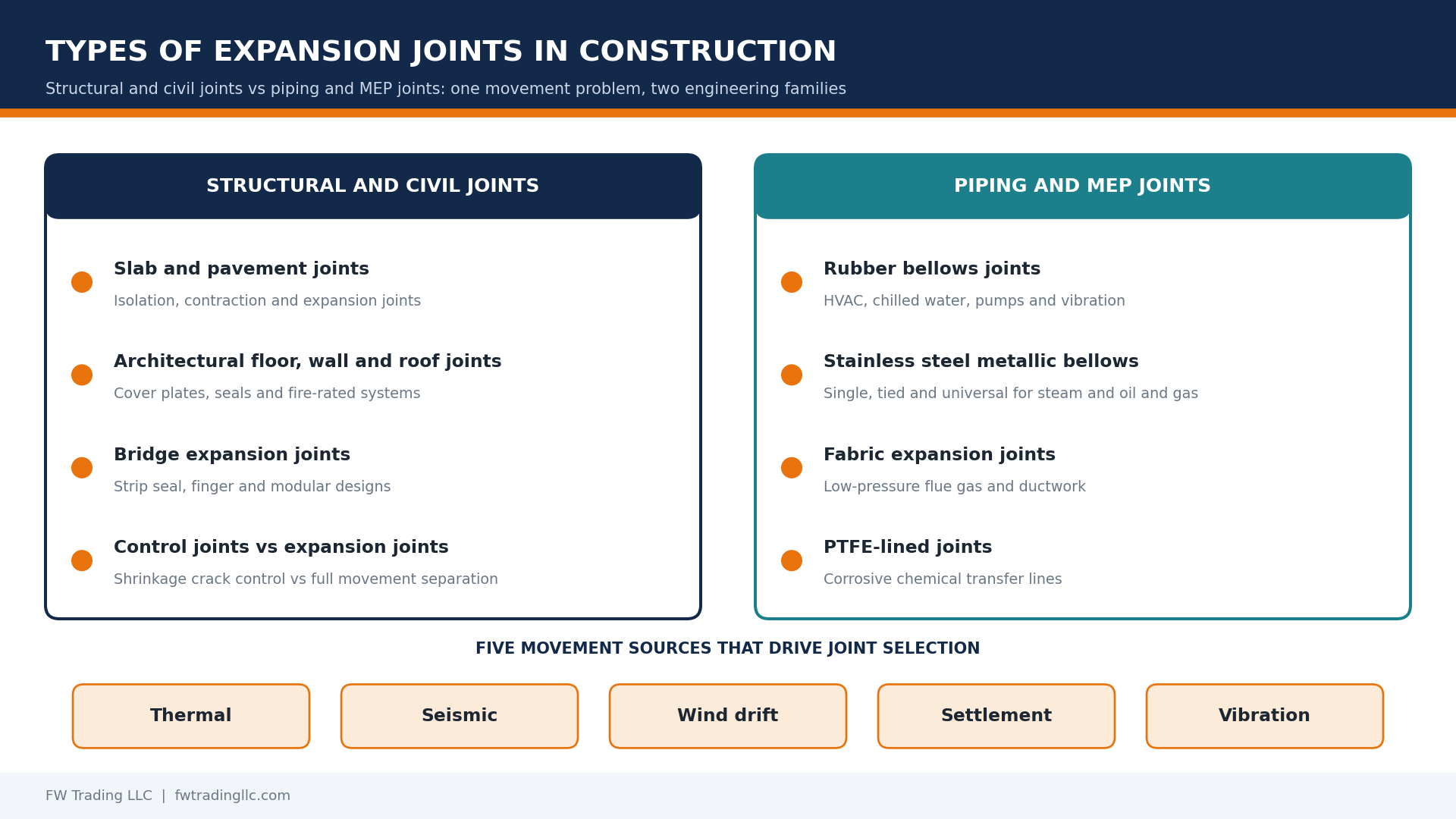
Expansion joints are engineered gaps or flexible assemblies that let adjoining structural or piping elements move without transferring damaging stress. They absorb thermal growth, seismic displacement, wind drift, settlement and vibration, protecting concrete, steel and equipment from cracking, buckling and fatigue.
Rigid systems resist movement until something yields. In a slab that means cracking, in a façade it means failed seals, and in a pipeline it means overloaded anchors or damaged pump casings. A joint gives movement a designed path, so damage never has to find one.
Dubai projects combine large thermal ranges with tall, stiff structures and long, hot pipelines. That combination makes the choice among types of expansion joints in construction a core design item rather than a late procurement line.
What Movements Do Expansion Joints Absorb?
All types of expansion joints in construction exist to absorb six movement sources: thermal expansion and contraction, seismic tremors, wind-induced drift, differential settlement, live-load variation and mechanical vibration. Each source differs in magnitude, frequency and direction, so each pushes the design toward a different joint type.
Thermal movement: slow, cyclic and predictable; it drives most slab, façade and pipeline joints.
Seismic displacement: rare, sudden and multi-directional; it sets building separation widths.
Wind drift: repeated lateral sway in towers; it governs joints between podium and tower.
Settlement: gradual and often one-directional; common where tower and podium foundations differ.
Load variation: traffic, crowd and equipment loads that deflect decks and slabs.
Vibration: high-frequency, low-amplitude motion from pumps, chillers and fans.
List the movement sources before looking at products. A joint rated only for axial thermal growth will not tolerate the lateral offset produced by a settling pump base.
How Much Thermal Movement Should You Expect in the UAE?
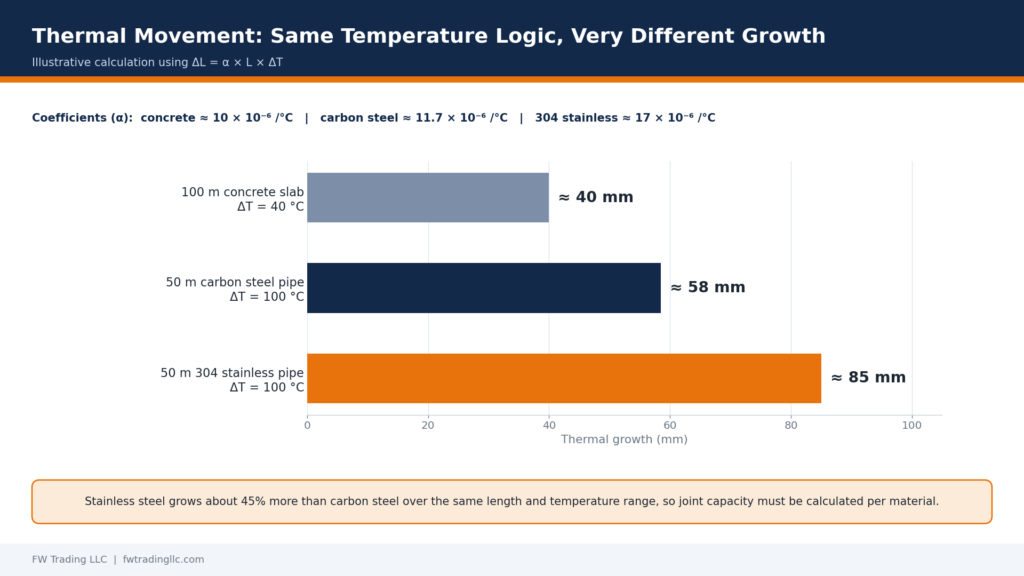
Thermal movement, which sizes every one of the types of expansion joints in construction, equals length multiplied by temperature change and the material’s expansion coefficient (ΔL = α × L × ΔT). A 100 m concrete slab with a 40 °C range moves about 40 mm, and a 50 m carbon steel line heated by 100 °C grows roughly 58 mm.
Austenitic stainless steel expands about 45 percent more than carbon steel, so a 304 line of the same length and range grows near 85 mm. Typical coefficients are about 10 × 10⁻⁶ per °C for concrete, 11.7 × 10⁻⁶ for carbon steel and 17 × 10⁻⁶ for 304 stainless.
Surface temperature matters more than air temperature. Dark roofs, exposed façade panels and uninsulated outdoor pipes in summer sun run far hotter than the air around them, so design ranges should use surface or fluid temperature rather than weather-station data.
What Are the Main Types of Expansion Joints in Construction?
The main types of expansion joints in construction fall into two families: structural joints for concrete, façades and bridges, and piping joints for HVAC, process and power systems. Structural joints separate building elements, while piping joints use flexible elements made from rubber, metal bellows, fabric or PTFE.
All types of expansion joints in construction follow one rule: the joint must absorb the full design movement without passing harmful force to neighbouring elements. They differ in materials, test standards and failure modes, which is why a single selection method rarely works across both.
Family
Typical joint
Primary movement
Typical location
Reference standard
Structural
Slab and pavement joints
Thermal, shrinkage
Roads, plazas, slab on grade
ACI 224.3R
Structural
Architectural floor, wall and roof joints
Thermal, drift, seismic
Towers, malls, podiums
ASTM E1966, EN 1366-4
Structural
Bridge joints
Thermal, traffic
Viaducts, flyovers
AASHTO LRFD
Piping
Rubber bellows
Vibration, small thermal
HVAC, pumps, chilled water
ASTM D2000 (material)
Piping
Metallic bellows
Large thermal, cyclic
Steam, power, oil and gas
EJMA, ASME B31.3, EN 14917
Piping
Fabric joints
Thermal, multi-directional
Flue gas, large ducts
Manufacturer design
Piping
PTFE-lined joints
Thermal plus corrosion
Chemical transfer lines
Manufacturer design
Which Types of Expansion Joints in Construction Do Civil Structures Use?
Civil structures use three types of expansion joints in construction: slab and pavement joints, architectural floor, wall and roof joints, and bridge joints. Each manages thermal drift, load and water ingress at a different scale, from a 10 mm sealant joint in a slab to a modular bridge joint handling several hundred millimetres of movement.
How Do Slab and Pavement Joints Handle Dubai’s Heat?
Within the types of expansion joints in construction, slab and pavement joints divide large concrete areas into panels that expand into filled gaps instead of cracking. Isolation joints separate slabs from columns and walls, contraction joints control shrinkage cracking, and true expansion joints give full-depth relief on long pavements, runways and plazas.
Sealant selection decides durability. Joint sealants must tolerate UV, heat softening and sand abrasion, and the backer rod should hold sealant depth near half the joint width. Poorly sized beads tear long before the concrete fails.
On exposed plazas and roads, dowel bars let panels slide while transferring wheel loads. Misaligned or corroded dowels lock the joint and turn thermal growth into edge spalling.
What Do Architectural Floor, Wall and Roof Joints Do?
Architectural joints let building sections move while keeping floors walkable, façades weathertight and fire compartments intact. Cover plates, elastomeric seals and foam-backed systems span the gap, and many assemblies need fire-resistive ratings tested to ASTM E1966, UL 2079 or EN 1366-4.
Floor joints in malls and podiums face foot and wheel traffic, so cover plates must carry trolley and cleaning-machine loads and stay flush. Wall joints need compressible fillers and weather seals that follow movement in both directions.
Roof joints are the most leak-sensitive. Curb-mounted or membrane-integrated systems must lap into the waterproofing, and they need UV-stable seals because roofs are the hottest, most exposed surfaces on a Dubai building.
Confirm the movement classification as well. Some joints accept only opening and closing, while others also handle shear and vertical offset, which seismic and wind drift often demand.
Which Bridge Expansion Joints Suit Heavy Transport Infrastructure?
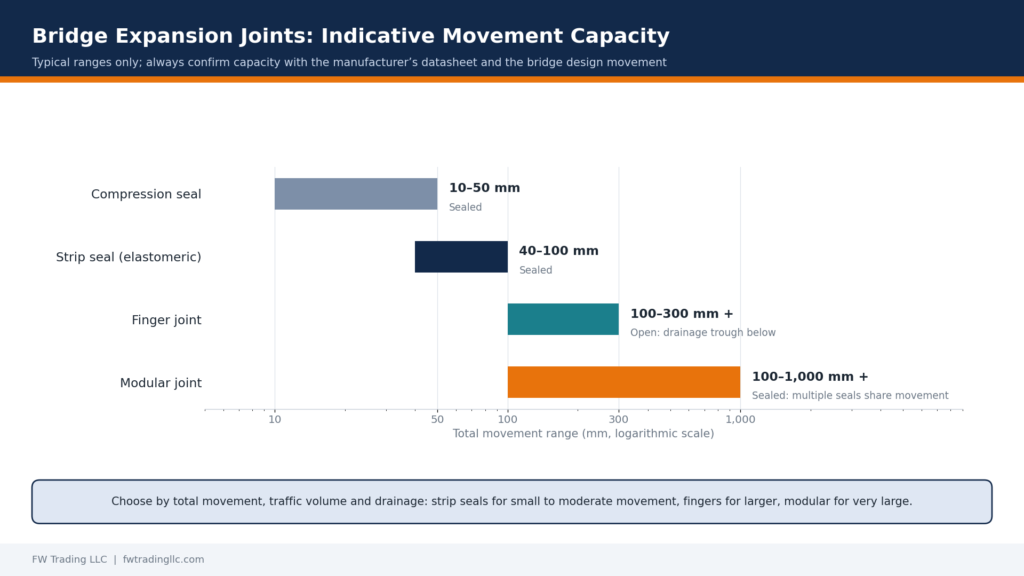
Bridge expansion joints, a major group among the types of expansion joints in construction, fall into three groups: elastomeric strip seal joints for small to moderate movement, finger joints for larger movement, and modular joints that share very large movement across several seals. Selection depends on total movement range, traffic volume and drainage.
Elastomeric and strip seal joints
A continuous elastomeric gland locks into steel extrusions anchored in each deck edge. Movement capacity typically runs to about 100 mm per seal, and the gland sheds water when installed in one continuous length. Debris-packed or torn glands are the usual leak source.
Finger joints
Interlocking steel fingers cantilever across the gap and slide as the deck moves. They handle larger movements, commonly beyond 100 mm, but they do not seal, so a drainage trough must sit beneath. Sand and debris collect in that trough and need regular clearing.
Modular joints
Steel centre beams on a support frame carry traffic, with elastomeric seals between beams. Each seal takes a share of the movement, so total capacity can reach many hundreds of millimetres. They cost more and need periodic inspection of bearings and seals.
Joint type
Indicative movement
Sealed against water?
Main maintenance point
Compression seal
10–50 mm
Yes
Seal set and debris
Strip seal
40–100 mm
Yes
Gland tears, edge rail anchorage
Finger joint
100–300 mm and above
No (drainage trough)
Trough cleaning, finger alignment
Modular joint
100–1,000 mm and above
Yes
Bearings, seals, centre beams
What Is the Difference Between Control Joints and Expansion Joints?
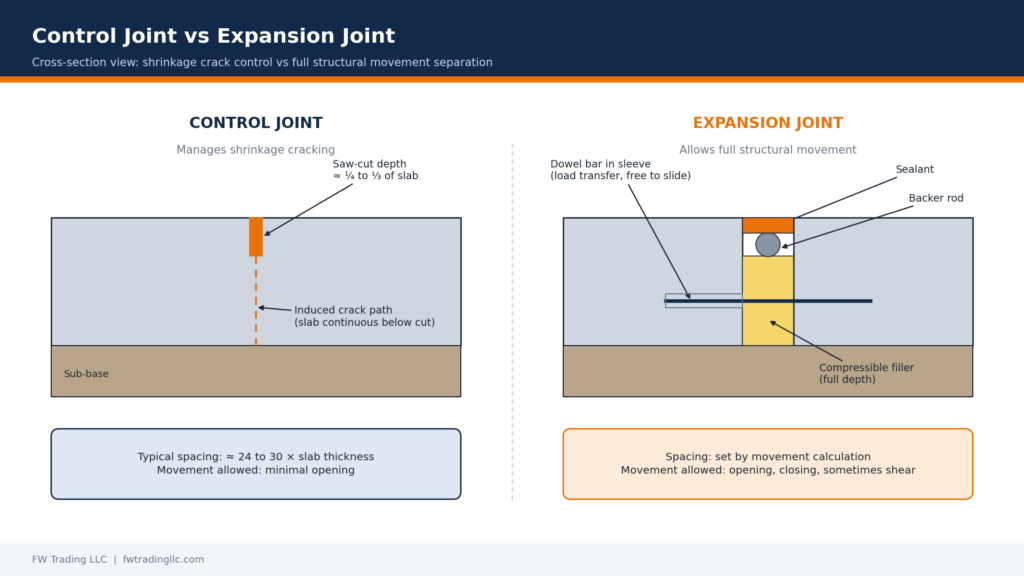
Control joints are shallow, planned cracks that manage concrete shrinkage, while expansion joints are full-depth separations that allow structural movement. A control joint reduces uncontrolled cracking but leaves the slab continuous below the cut; an expansion joint breaks the structure completely so adjoining sections move independently.
Feature
Control joint
Expansion joint
Purpose
Direct shrinkage cracking
Allow thermal and structural movement
Depth
About one quarter to one third of slab thickness
Full depth of the element
Typical spacing
About 24 to 30 times slab thickness
Set by movement calculation and design
Filler
Sealant only, often over a backer rod
Compressible filler plus sealant or cover system
Load transfer
Aggregate interlock or dowels
Dowels or sliding plates
Movement allowed
Minimal opening
Opening, closing and sometimes shear
Confusing the two is a common site error. Contractors sometimes saw control joints where designers specified full-depth separations, and the building then cracks at the next hot cycle.
How Wide Should a Building Separation Joint Be?
Building separation joints must exceed the combined movement of the adjoining structures under thermal, wind and seismic effects. Governing codes combine both structures’ displacements, either by direct sum or by square root of the sum of squares, so tower and podium gaps often exceed what thermal calculations alone suggest.
Tall buildings add wind drift to the thermal case. A tower and an adjacent podium differ in stiffness and period, so their displacements rarely match. Joint covers must therefore accept shear and vertical offset, not just opening and closing.
Differential settlement adds a slow third movement. Where a tower sits on piles and the podium on a raft, the gap often shifts vertically in the first years. Specify covers with vertical tolerance and plan for later adjustment.
Which Types of Expansion Joints in Construction Serve Piping and MEP Systems?
Piping and MEP systems rely on four types of expansion joints in construction: rubber bellows, stainless steel metallic bellows, fabric joints and PTFE-lined joints, chosen by temperature, pressure, media and movement. Rubber suits low-pressure vibration duty, metal suits high-pressure heat, fabric suits low-pressure ducts, and PTFE suits aggressive chemicals.
Piping expansion joints UAE contractors specify must also survive long, hot summers and frequent start-stop cycles. The sections below cover movement types first, then each joint family in turn.
How Do Axial, Lateral and Angular Movements Differ?
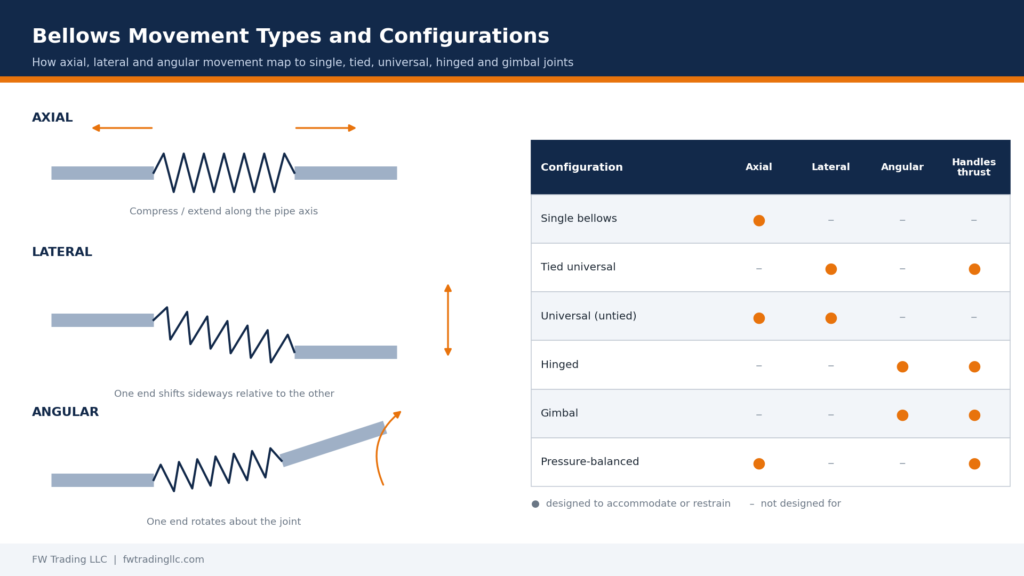
Axial movement compresses or extends a joint along the longitudinal axis of the pipe. Lateral movement shifts one end sideways relative to the other, while angular movement rotates one end about a hinge point in one plane or in every plane. Each configuration suits a different combination.
Single bellows: axial movement only; needs main anchors and guides.
Tied universal bellows: two bellows with tie rods; absorbs lateral movement and restrains pressure thrust.
Universal (untied) bellows: two bellows on a centre spool; large lateral movement, but pressure thrust passes to anchors.
Hinged joint: angular movement in one plane; pairs absorb larger offsets.
Gimbal joint: angular movement in any plane.
Pressure-balanced joint: offsets thrust so anchors see lighter loads.
Pressure thrust deserves attention. A bellows with an effective area of 490 cm² at 10 bar generates about 49 kN, roughly five tonnes, pushing the pipe ends apart. Anchors, equipment nozzles or the structure must carry that force unless the joint is tied or balanced.
When Should You Use Rubber Expansion Joints?
Among the types of expansion joints in construction, rubber joints suit low-pressure, low-temperature services where vibration, noise and misalignment dominate, such as chilled water, condenser water, pumps and chillers. Their elastomer arches absorb high-frequency vibration, small thermal movement and installation misalignment while reducing noise carried along the pipe.
Material choice depends on media. EPDM suits water and glycol, NBR suits oils and fuels, and fluoroelastomer grades handle higher temperatures and aggressive media. Match the elastomer to both the fluid and the ambient exposure.
Edge cases catch many installations. Rubber joints pass pressure thrust to pump flanges unless control rods are fitted, and they cope poorly with repeated pressure surges such as water hammer without limit rods. Insulation and paint can also hide cover damage.
When Do Stainless Steel Metallic Bellows Make Sense?
Of the types of expansion joints in construction, stainless steel metallic bellows suit high-pressure, high-temperature and cyclic services such as steam lines, power plants and oil and gas pipelines. Multi-ply bellows in 304, 316L or 321 stainless steel absorb thermal growth without elastomer ageing, and they are built as single, tied or universal assemblies.
Design follows EJMA and ASME B31.3 principles. Cycle life depends on movement per convolution, ply count and temperature, so a joint with adequate total movement can still fail early if it runs near its stress limit.
Guides are not optional. Common EJMA practice places the first guide within four pipe diameters of the joint and the second within fourteen, which prevents squirm in single bellows. Missing guides are a leading cause of buckled bellows.
Within the types of expansion joints in construction, fabric joints fit low-pressure air, flue gas and ductwork systems that need large, multi-directional movement and thermal flexibility. Layers of coated glass fibre, PTFE or silicone fabric form a flexible belt, with insulation layers added where gas temperatures are high.
They operate close to atmospheric pressure, typically well below 1 bar. That makes them common in boiler exhaust, generator stacks and large HVAC ducts, but unsuitable for pressurised liquid lines.
Condensation matters. Acid dew point condensation can attack the fabric and frame, so designers choose material layers using gas composition and minimum temperature, not only maximum temperature.
What Are PTFE-Lined Expansion Joints Used For?
Among the types of expansion joints in construction, PTFE-lined joints serve chemical transfer and industrial processing lines where corrosion resistance matters more than high pressure. A PTFE liner or bellows resists nearly all industrial chemicals, so these joints handle acids, solvents and ultra-pure fluids that would attack rubber or stainless steel.
Limits are temperature, vacuum and permeation. PTFE is typically rated up to about 200 °C, vacuum service needs reinforcement, and vapour permeation can attack outer metal parts in aggressive services.
What Are Braided, Double Sphere and Union Type Joints?
Braided, double sphere and union type joints are flexible connectors for pump, pipeline and modular installations. Braided assemblies absorb vibration and multi-directional movement, double sphere joints accommodate larger offsets with a strong seal, and union type expansion joints simplify assembly and disassembly for maintenance.
These configurations work best where space is tight or maintenance is frequent. Verify pressure and temperature ratings against the datasheet, because the same product name can cover different materials and ratings.
Rubber vs Metallic Expansion Joints: Which Should You Specify?
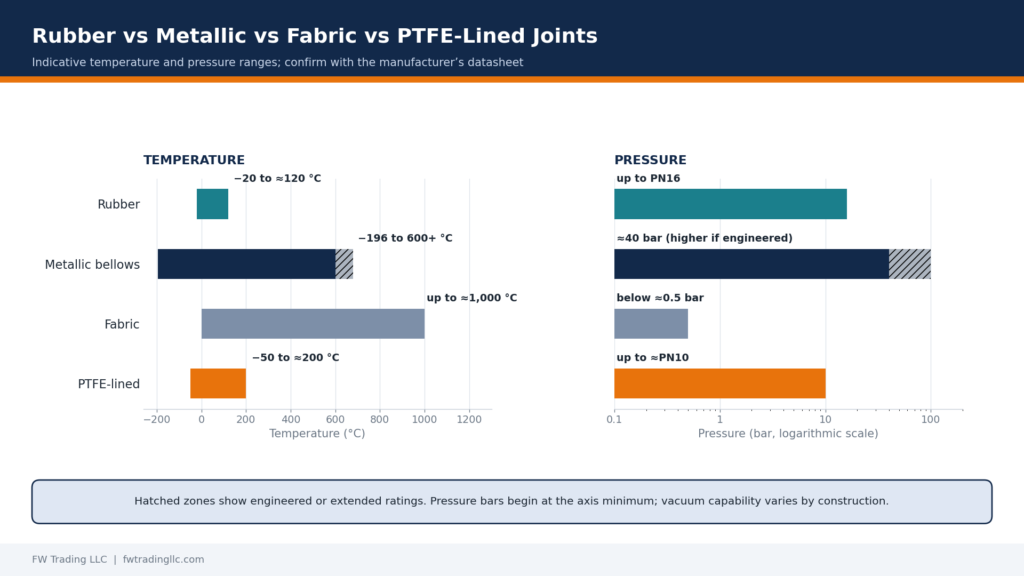
Among the types of expansion joints in construction piping, specify rubber for low-pressure, low-temperature, vibration-dominated services and metallic bellows for high-pressure, high-temperature or hazardous media. Rubber costs less and installs more easily, while metal offers higher ratings and longer cycle life under repeated thermal cycling.
Parameter
Rubber
Metallic bellows
Fabric
PTFE-lined
Typical temperature
−20 to about 120 °C (grade dependent)
−196 to 600 °C and above (alloy dependent)
Up to about 1,000 °C (layer dependent)
−50 to about 200 °C
Typical pressure
Up to PN16
Vacuum to about 40 bar; higher when engineered
Near atmospheric, below about 0.5 bar
Up to about PN10
Movement capacity
Moderate, multi-directional
High axial; lateral and angular by configuration
Very high, multi-directional
Low to moderate
Vibration and noise damping
Excellent
Moderate
Good
Moderate
Best applications
HVAC, chilled water, pumps, water treatment
Steam, power plants, oil and gas
Flue gas, large ducts
Chemical transfer, process lines
Key limitation
UV, ozone, hydrocarbons, thrust on flanges
Cost; needs anchors and guides
Low pressure only; condensation
Temperature, vacuum, permeation
Treat these figures as indicative. Rating depends on size, construction and manufacturer, so confirm every value against the datasheet and the project specification.
Need help matching a joint to your duty? Review FW Trading’s expansion joints range and share your movement, pressure and media data with our team. We will point you to a suitable construction and the datasheet that supports it.
How Does the UAE and GCC Climate Affect Expansion Joint Performance?
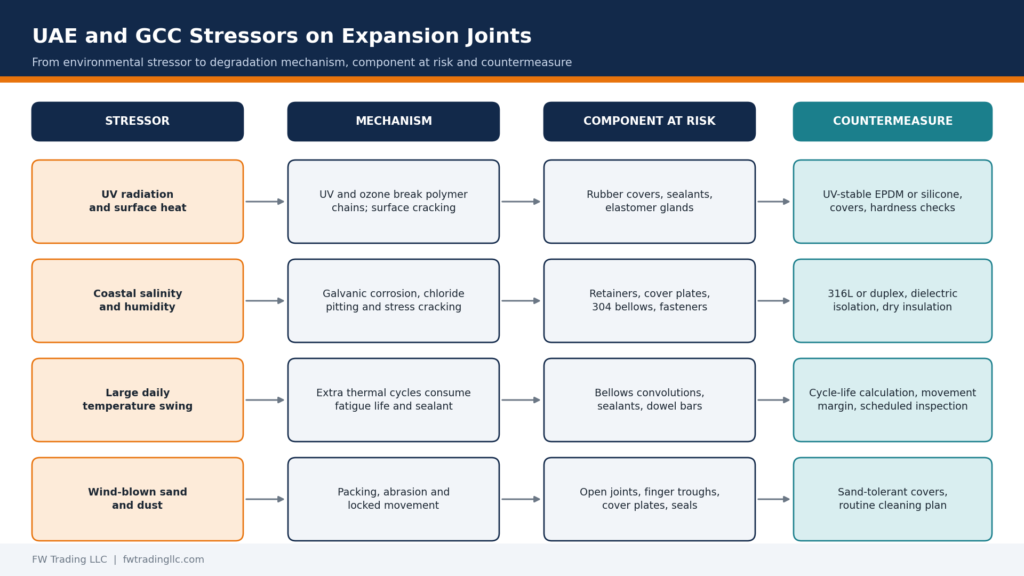
UAE and GCC conditions combine large daily temperature swings, intense UV radiation, coastal salinity, high humidity and wind-blown sand. These factors age elastomers faster, drive galvanic and chloride-related corrosion on retainers and bellows, and add fatigue cycles, so every one of the types of expansion joints in construction needs harsher derating than temperate-climate catalogue values suggest.
The checklist in this section applies to expansion joints in building construction Dubai projects and to most GCC sites. Each factor attacks a different component, as the diagram below shows.
Why Does UV Radiation Degrade Elastomeric Seals?
UV radiation and ozone break polymer chains in exposed elastomers, causing surface cracking, hardening and loss of elasticity. High UV intensity and heat accelerate this ageing in the UAE, so exposed seals need UV-stable compounds such as EPDM or silicone, protective covers or metal shields.
Cracks begin on the outer surface and are easy to miss. Inspections should include a tactile check for hardening, because a brittle seal can pass a visual check yet tear at the next movement cycle.
How Do Coastal Salinity and Humidity Cause Corrosion?
Salt-laden air and high humidity form conductive films on metal surfaces, which accelerate galvanic corrosion where dissimilar metals touch and attack stainless steel through chloride pitting and stress corrosion cracking. Coastal sites in Dubai, Sharjah and Abu Dhabi therefore need corrosion-resistant grades and isolated metal interfaces.
Specify 316L or duplex grades for chloride exposure instead of defaulting to 304.
Isolate dissimilar metals, such as aluminium cover plates on steel fixings, with dielectric washers and sleeves.
Keep insulation dry on hot austenitic stainless bellows; trapped chlorides can cause external stress corrosion cracking above roughly 60 °C.
Coat carbon steel retainers and use stainless fasteners compatible with the plate material.
How Do Diurnal Swings and Sand Affect Cycle Life?
Large daily temperature swings multiply thermal cycles over a joint’s life, which consumes fatigue life in bellows and wears sealant in structural gaps. Wind-blown sand also packs open joints and abrades seals, preventing free movement and causing edge damage or buckling.
Calculate cycle life using daily and start-stop cycles, not only seasonal ones. A hot water line that cycles daily accumulates far more cycles than a design based on annual shutdowns would predict.
Open structural joints on plazas and car parks should use sand-tolerant covers, and maintenance plans should schedule cleaning.
Which Standards and Codes Govern Expansion Joints in the UAE?
Expansion joint compliance rests on EJMA for metal bellows design, ASME B31.3 and EN 13480 for piping systems, EN 14917 for metal bellows, ASTM standards for materials and sealants, AASHTO for bridge joints and fire standards for building joints. Dubai projects must also meet the Dubai Building Code and Dubai Municipality and Civil Defence requirements.
Dubai Building Code, Dubai Municipality and UAE Fire and Life Safety Code
Local building, structural and fire compliance
All Dubai building projects
Standards differ across the types of expansion joints in construction, and they set minimums only; consultants and project specifications set the actual requirements. Ask for manufacturer test reports, material certificates and cycle-life calculations as submittals, and confirm which edition applies, because municipal references are updated periodically.
Material traceability extends to the adjoining pipework. Our guide to buttweld fittings types and standards explains how fitting standards align with bellows end connections.
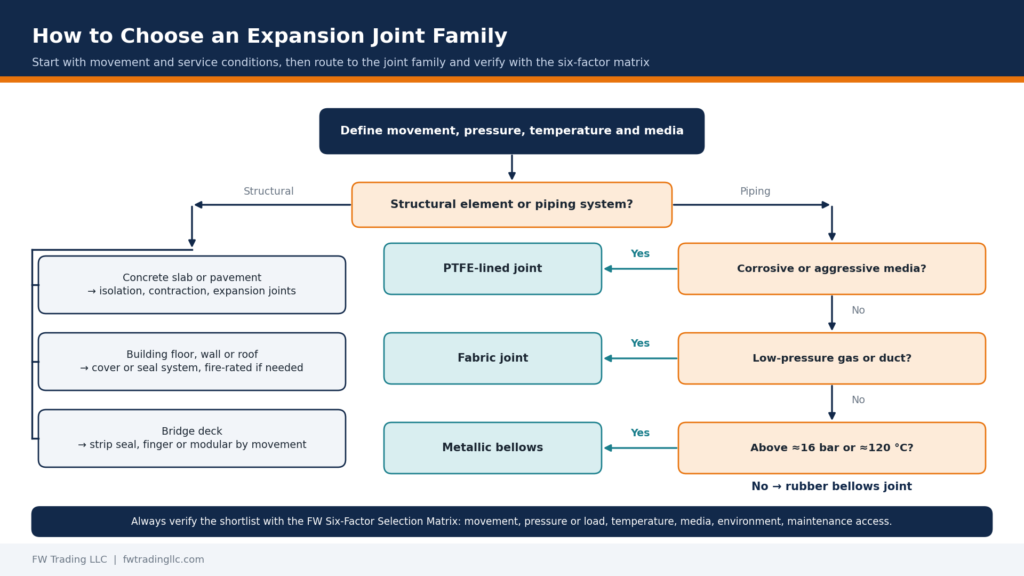
How Do You Choose Among the Types of Expansion Joints in Construction?
Choose among the types of expansion joints in construction by matching six factors to the system: movement, pressure or load, temperature, media or exposure, environment and maintenance access. Define movement first because it sets the joint family, then confirm that ratings and materials survive the worst operating and installation conditions.
What Is the FW Six-Factor Selection Matrix?
The FW Six-Factor Selection Matrix scores each candidate joint against movement, pressure or load, temperature, media or exposure, environment and maintenance access. Any factor scoring zero eliminates the candidate, which stops a strong score in one category from hiding a fatal weakness in another.
Factor
Question to ask
Data needed
Elimination rule
1. Movement
Is capacity above design movement, including cycles?
Axial, lateral, angular values; cycle count
Capacity below design movement
2. Pressure or load
Do ratings exceed design and test pressure or wheel load?
Design and test pressure; thrust; traffic class
Rating below test pressure or load
3. Temperature
Do materials hold across fluid, ambient and surface extremes?
Minimum, maximum and installation temperature
Outside material limits
4. Media or exposure
Is every wetted and exposed material compatible?
Fluid, chemicals, UV, salinity
Incompatible material
5. Environment
Is the joint protected against sand, salt and moisture?
Location, indoor or outdoor, coastal or inland
No protection strategy
6. Maintenance access
Can the joint be inspected and replaced?
Access, shutdown windows, service life target
No access and short life
What Information Does a Supplier Need to Quote an Expansion Joint?
A supplier needs eight data points to quote any of the types of expansion joints in construction accurately: size and end connections, media, design and test pressure, temperature range, movement and cycle count, location and exposure, required standards, and certificates. Missing data forces assumptions that can turn into site failures.
Nominal size, flange rating and end-connection standard.
Fluid or gas, including concentration and contaminants.
Design pressure, test pressure and any vacuum condition.
Minimum, maximum and installation temperature.
Axial, lateral and angular movement, plus expected cycles.
Indoor or outdoor location, coastal exposure, UV and sand.
Applicable standards, such as EJMA, ASME B31.3 or EN 14917.
Required certificates, such as material test certificates.
What Does Expansion Joint Installation Involve in GCC Projects?
Installation of all types of expansion joints in construction follows four controls: verify design movement, set the joint at the correct installation temperature, anchor and guide the pipe or structure correctly, and protect the joint during testing. Skipping any control causes the most common site failures, even when the joint itself is correctly specified.
Check the joint width against the temperature at the time of fixing, using the design movement chart.
Clean joint faces, remove laitance and dust, and apply primer where the sealant manufacturer requires it.
Install backer rod or bond-breaker at the specified depth before sealing.
Fix cover plates on one side only, so the other side can slide.
Lap waterproofing and fire seals correctly into adjoining systems.
Record installation temperature and photograph the joint before it is concealed.
Piping expansion joint checklist:
Verify that anchors, guides and supports are designed for pressure thrust, including test pressure.
Remove shipping bars after installation and before pressure testing, while keeping control rods fitted.
Align pipes within tolerance; do not use a joint to correct misalignment unless it is rated for it.
Use compatible flanges and gaskets, flat mating faces for rubber joints, and a controlled bolt tightening sequence.
Cap hydrotest pressure at the joint’s test rating and add temporary restraint where required.
Fit removable insulation covers to bellows and shield outdoor rubber joints from UV.
Flange selection affects joint sealing, so review the differences in our guide to slip-on vs blind flanges before finalising connection details.
Why Do Expansion Joints Fail in Service?
Across all types of expansion joints in construction, failures occur when real movement, pressure or exposure exceeds the design basis, usually because of missing anchors, wrong materials, installation errors or neglected inspection. Most failures trace to a handful of repeatable causes that checklists and routine inspection can catch before service.
Failure vector
Typical cause
Early sign
Control
Bellows squirm or buckling
Missing guides, excess pressure
Lateral bowing under pressure
Guides at 4 and 14 diameters; pressure limit check
Anchor overload
Pressure thrust ignored in design or test
Displaced supports, flange leaks
Design anchors for thrust, including hydrotest
Rubber cover cracking
UV, ozone, heat
Surface crazing, hardening
UV-stable compound, shields, hardness checks
Chloride stress corrosion cracking
Wet insulation on hot 304 near the coast
Weeping at convolutions
316L or duplex; dry insulation
Over-extension during test
Rods or bars removed too early
Deformed convolutions
Keep control rods; limit test pressure
Sealant adhesion loss
Dusty joint faces, wrong backer rod
Edge peeling
Clean, prime, set correct depth
Locked joint
Sand packing, misaligned dowels
Spalled edges, cracked covers
Cleaning schedule, dowel alignment checks
Galvanic corrosion at retainers
Dissimilar metals in contact
Corrosion at fixings
Dielectric isolation, compatible fasteners
Inspection intervals should reflect exposure. Coastal and outdoor joints deserve at least annual checks for cover condition, corrosion and movement indicators, while pump-connected rubber joints benefit from checks after any pressure event. Document each reading so trends show before failure.
Key Takeaways on Types of Expansion Joints in Construction
The types of expansion joints in construction differ less in name than in the movement, pressure and exposure they are built to handle. Selecting by movement first, then by media, pressure and environment, prevents the mismatches that cause most site failures.
Calculate movement from surface or fluid temperature, not air temperature.
Separate control joints from expansion joints in drawings and on site.
Match the types of expansion joints in construction to the service: rubber for low-pressure vibration, metal for pressure and heat, fabric for ducts and PTFE for corrosive media.
Derate for UV, salinity, sand and daily cycling in UAE conditions.
Design anchors and guides for pressure thrust before ordering the joint.
Ready to specify with confidence? Send FW Trading LLC your movement, pressure, temperature and media data, and our team will recommend suitable expansion joints with datasheets for your Dubai or GCC project. Consult our engineering team to review your design before you order.
Frequently Asked Questions
What are the main types of expansion joints in construction?
The main types of expansion joints in construction are structural joints, which include slab, pavement, architectural and bridge joints, and piping joints, which include rubber, metallic bellows, fabric and PTFE-lined designs. Structural joints separate building elements, while piping joints absorb thermal movement and vibration in pipelines and ducts.
What is the difference between rubber and metallic expansion joints?
Rubber joints suit low-pressure, low-temperature services and damp vibration and noise well, typically up to PN16 and about 120 °C. Metallic bellows handle higher pressure and temperature, resist cycling fatigue and suit steam, power and oil and gas, but need anchors and guides.
How does the UAE climate affect expansion joint selection?
The UAE climate adds large daily temperature swings, strong UV, coastal salinity and wind-blown sand. These conditions age elastomers, corrode dissimilar metals, add fatigue cycles and pack open joints, so specifiers should choose UV-stable compounds, 316L or duplex metals and joints that can be inspected and cleaned.
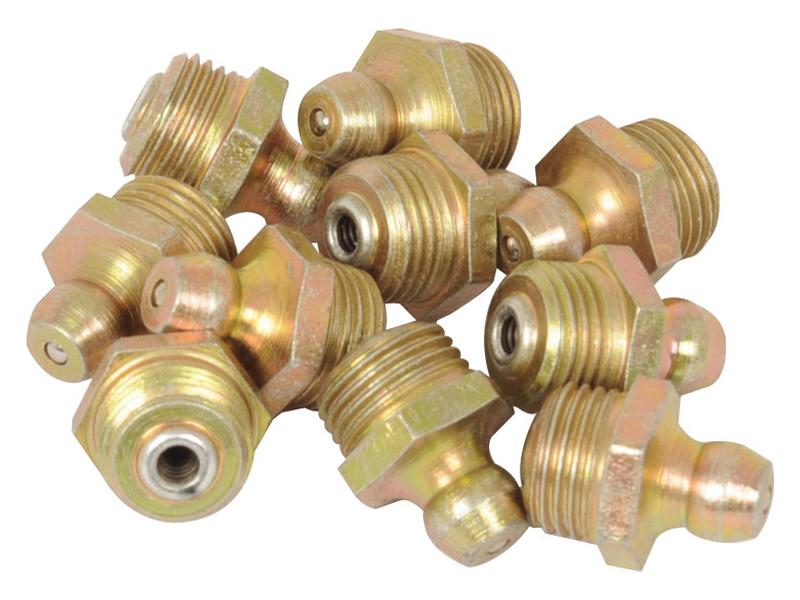
Lubrication is essential for the efficiency and longevity of machinery. Grease nipples are small but critical fittings that allow grease to be applied directly to bearings, joints, and other moving parts. In Dubai, FW Trading provides high-quality grease nipples made from carbon and stainless steel, ensuring durability, corrosion resistance, and compatibility with standard grease guns.
These fittings are widely used across industries such as automotive, construction, manufacturing, and heavy machinery. Using the right grease nipple reduces wear and tear, prevents downtime, and maintains smooth operation of equipment.
What Are Grease Nipples and Why They Matter?
Grease nipples, also called lubrication nipples or Zerk fittings, are mechanical components that allow lubricant to be injected into moving parts without dismantling machinery. They ensure smooth operation, reduce friction, and extend the life of industrial equipment.
Key Features:
Durable construction from carbon steel or stainless steel
Zinc-plated or nickel-plated finishes for corrosion resistance
Compatible with standard grease guns
Reliable lubrication for bearings, joints, and pivots
Types of Grease Nipples You Should Know
Choosing the right type of grease nipple ensures effective lubrication in all industrial applications.
1. Straight Grease Nipples
These are the most common type, used where the grease gun can access the fitting directly in a straight line. Ideal for general machinery lubrication points.
2. Angled Grease Nipples
Designed for hard-to-reach areas, these nipples come in 45° or 90° angles to ensure proper lubrication in tight spaces.
3. Zerk Grease Nipples
These feature a built-in ball check valve that prevents contaminants from entering the system while allowing grease to flow smoothly.
4. Specialty Grease Nipples
Custom-made fittings designed for high-pressure, high-temperature, or extreme environmental conditions.
Industrial Applications of Grease Nipples
Grease nipples are essential wherever machinery requires regular lubrication.
Mechanical Lubrication Points
Used at critical lubrication points in industrial machines to reduce friction and improve performance.
Bearings and Joints
Deliver grease directly to bearings, joints, and pivots to prevent wear and extend component life.
Automotive and Heavy Equipment
Essential in vehicles, construction machinery, and agricultural equipment for consistent maintenance.
Industrial Machinery
Crane systems, turbines, conveyors, presses, and production lines rely on grease nipples for smooth operation.
Oil and Gas Industry
Corrosion-resistant grease nipples are used on offshore platforms, pipelines, and refineries, where environmental conditions are harsh.
Materials and Specifications for Durability
The longevity and performance of grease nipples depend on materials and protective coatings.
Specification
Details
Material
Carbon Steel & Stainless Steel
Finish/Coating
Zinc-plated, Nickel-plated, or customized
Compatibility
Standard grease guns and fittings
Application
Bearings, joints, and mechanical lubrication points
Origin
Dubai, UAE
Carbon steel offers cost-effective durability, while stainless steel provides superior corrosion resistance. Plated finishes protect fittings against rust and environmental damage.
Benefits of Using High-Quality Grease Nipples
Extended Equipment Life – Reduces friction, heat, and wear in moving parts.
Ease of Maintenance – Grease can be applied without dismantling equipment.
Cost Efficiency – Minimizes downtime, repairs, and replacement costs.
Universal Compatibility – Works with standard grease guns, simplifying maintenance.
Tips for Proper Installation and Maintenance
Proper installation and regular maintenance ensure optimal performance of grease nipples:
Verify compatibility with grease guns and machinery.
Inspect nipples regularly for wear, blockage, or damage.
Clean the surface before lubrication to prevent contamination.
Replace damaged or worn nipples immediately.
Apply the correct type of grease suitable for the machine and operating environment.
These practices minimize equipment failure and maintain consistent machinery performance.
How to Choose Reliable Grease Nipples in Dubai
Selecting the right grease nipple requires attention to:
Material – Stainless steel for corrosive environments, carbon steel for general use.
Size and Thread Type – Ensure proper compatibility with machinery.
Angle – Straight or angled based on accessibility.
Pressure and Load – Choose nipples designed to handle system pressure requirements.
FW Trading provides a wide range of grease nipples that meet these criteria, ensuring efficient lubrication for industrial machinery in Dubai.
AI Overview
Discover high-quality grease nipples in Dubai. Learn about types, applications, materials, and maintenance for smooth industrial lubrication with FW Trading.
FAQs
What is the main purpose of a grease nipple?
A grease nipple allows lubricant to reach bearings, joints, and pivots, reducing friction and preventing wear.
Are grease nipples compatible with all grease guns?
Yes, high-quality grease nipples are designed to work with standard grease guns for easy maintenance.
Which materials are best for grease nipples?
Carbon steel offers durability, and stainless steel provides superior corrosion resistance in harsh environments.
How often should grease nipples be inspected?
Regular inspections are recommended, especially for high-stress machinery, to prevent blockages and ensure proper lubrication.
Why is sourcing high-quality grease nipples important?
High-quality grease nipples ensure smooth machinery operation, reduce downtime, and extend equipment life.
Conclusion
Grease nipples are critical for reducing friction, preventing wear, and ensuring smooth operation of industrial machinery. Choosing the right type, material, and installation method guarantees optimal performance and lowers maintenance costs.
For high-quality grease nipples in Dubai, FW Trading offers durable solutions compatible with all standard grease guns. Contact FW Trading today to maintain efficient machinery operation and prevent costly downtime.
Explore More Expert Insights
Discover guides on carbon & stainless steel pipes, flanges, fittings, and high-pressure products for your next project.
When it comes to industrial piping systems, creating durable and leak-proof connections is essential. One of the most reliable solutions is buttweld fittings, widely used in chemical plants, oil and gas industries, power plants, and water treatment facilities. These fittings provide strong joints capable of handling high pressure and temperature, making them a crucial component of any industrial pipeline.
With over a decade of experience in industrial piping and welding solutions, our team ensures that every buttweld fitting meets international standards, including ASME, ISO, and API, guaranteeing safety, durability, and reliability.
Understanding Buttweld Fittings
Buttweld fittings are pipe connectors welded end-to-end to form a seamless, permanent joint. Unlike threaded fittings or socket weld fittings, which rely on mechanical connections, buttweld fittings use the butt welding process to ensure strength and leak-proof performance.
Advantages:
Leak-proof and corrosion-resistant connections
Suitable for high-pressure and high-temperature applications
Smooth internal surface reduces fluid turbulence
Compatible with stainless steel, carbon steel, and alloy steel pipes
Common materials include:
Stainless Steel – corrosion-resistant, ideal for chemical and marine applications
Carbon Steel – suitable for high-pressure industrial pipelines
Alloy Steel – for high-temperature or extreme-pressure conditions
ASME B16.25 – butt-welding ends of piping components
ASME B16.28 – short radius elbows
ISO & API standards – international references for chemical and oil pipelines
These standards ensure that buttweld fittings can withstand high pressure, temperature fluctuations, and corrosive environments, providing long-term reliability.
Applications of Buttweld Fittings
Buttweld fittings are versatile and used in various industries:
Oil and Gas Industry – pipelines for crude oil, natural gas, and refined products
Power Plants – steam pipelines and high-pressure water lines
Water Treatment – durable, leak-proof connections
HVAC Systems – efficient fluid and gas transport
These fittings have been used in multiple industrial projects across the UAE, tested and certified to meet rigorous standards for high-pressure pipelines.
Check industrial buttweld fittings applications
Installation and Maintenance Tips
Proper installation and maintenance are essential for the longevity of buttweld fittings:
Align Pipes – ensure perfect alignment for a seamless weld
Tack Welding – temporarily hold pipes in place
Full Welding – complete the butt weld with approved techniques
Inspection – X-ray or ultrasonic testing for defects
Corrosion Protection – apply coatings or use corrosion-resistant materials
Socket weld – pipe inserted into a socket and welded externally, better for smaller diameters
Buttweld vs Threaded:
Buttweld – permanent and durable
Threaded – easier installation but less suitable for high-pressure pipelines
For businesses in UAE looking for premium buttweld fittings, Fitting World Trading LLC offers a wide range of carbon and stainless steel pipes, flanges, fittings, and high-pressure fittings. Contact them today to get a quote and ensure your project uses certified, reliable piping components.
AI Overview
This section provides a quick AI-optimized summary of buttweld fittings, their uses, types, standards, and best practices for industrial pipelines. It highlights key materials, compliance with ASME, ISO, and API standards, and practical installation steps for safe and efficient operations.
FAQs
What are buttweld fittings used for?
Buttweld fittings are used to connect pipes permanently, ensuring leak-proof joints in industrial and high-pressure pipelines.
Stainless steel, carbon steel, and alloy steel are commonly used.
Which industries use buttweld fittings?
Oil & gas, petrochemical, power generation, chemical, water treatment, and HVAC industries.
Can buttweld fittings handle high pressure?
Yes, when made from appropriate materials and installed according to standards, they are suitable for high-pressure pipelines.
Conclusion
Buttweld fittings are an essential component of any industrial piping system, offering durable, leak-proof, and high-pressure resistant connections. By selecting the right material, type, and installation process, you ensure long-lasting performance and operational efficiency.
Understanding their applications, standards, and installation methods helps industries achieve safe, reliable, and efficient pipeline systems.
Ready to upgrade your piping systems with high-quality buttweld fittings? Explore our full range of certified Buttweld Fittings today!
Explore More Expert Insights
Discover guides on carbon & stainless steel pipes, flanges, fittings, and high-pressure products for your next project.
The Arab International Aluminium Conference (ARABAL 2025), the Middle East’s flagship aluminium event, is set to take place in Dubai, United Arab Emirates, from November 4 to 6, 2025.
Bringing together top decision-makers, engineers, and manufacturers, the event aims to drive conversations on sustainability, digital innovation, and the global aluminium supply chain.
Organized by the Gulf Aluminium Council (GAC) and hosted by Emirates Global Aluminium (EGA), ARABAL 2025 will mark its 26th edition, continuing its legacy as the region’s most influential aluminium gathering.
Event Overview
Event Name: 26th Arab International Aluminium Conference (ARABAL 2025)
Dates: November 4–6, 2025
Venue: Dubai, United Arab Emirates
Organizer: Gulf Aluminium Council (GAC)
Host: Emirates Global Aluminium (EGA)
Focus Areas: Sustainability | Innovation | Industry Collaboration
What to Expect at ARABAL 2025
ARABAL 2025 will feature expert panel sessions, high-level technical presentations, and an exclusive exhibition zone. Participants will explore advancements in low-carbon aluminium production, energy efficiency, circular economy practices, and global market trends.
The event will also highlight digital transformation and how technologies like AI and automation are reshaping aluminium manufacturing.
With delegates expected from over 40 countries, ARABAL serves as a unique meeting point for manufacturers, suppliers, investors, and policymakers.
Conference Schedule
Day 1 – November 4, 2025
Opening ceremony and keynote sessions by international aluminium leaders.
Day 2 – November 5, 2025
Panel discussions on sustainability, recycling innovation, and production efficiency.
Day 3 – November 6, 2025
Workshops on trade growth, technology adoption, and future strategies followed by closing remarks.
Distinguished Speakers at ARABAL 2025
The 26th Arab International Aluminium Conference (ARABAL 2025) will feature an exceptional lineup of global leaders, innovators, and industry experts sharing valuable insights on the aluminium sector’s future.
Among the confirmed speakers are:
Satish Pai – Managing Director, Hindalco Industries Bringing decades of experience in aluminium manufacturing and sustainable production.
Abdulnasser Bin Kalban – CEO, Emirates Global Aluminium (EGA) Leading the UAE’s largest industrial company and one of the world’s biggest aluminium producers.
Matthew Chamberlain – CEO, London Metal Exchange (LME) Offering a global perspective on aluminium pricing, trade, and the evolving commodities market.
Check out the event website to know more about the full list of speakers, their profiles and sessions.
Registration Information
Professionals and companies can now register for ARABAL 2025 through the official website.
Registration Fees:
GAC Members: US$ 1895 per delegate (from 1st October 2025)
Non-Members: US$ 1995 per delegate (from 1st October 2025)
Special Group Discount: 15% off for five or more delegates from the same company. Early registration ensures access to all sessions, networking events, and exhibition zones.
Main Highlights
Insightful discussions on aluminium sustainability and global competitiveness
Showcase of new materials, production technology, and recycling innovations
Networking sessions connecting buyers, suppliers, and manufacturers
Workshops on market expansion and investment trends in the Gulf region
Conclusion
The ARABAL 2025 Conference in Dubai will once again position the UAE as a hub for aluminium innovation and trade, fostering collaboration across the global supply chain.
As the region continues to strengthen its industrial base, Fitting World Trading LLC stands as a leading supplier of premium aluminium in Dubai,. The company provides a complete range of high-quality aluminium products and components trusted by construction and manufacturing sectors alike.
Partner with Fitting World Trading LLC today to source reliable aluminium fittings and enhance your next industrial project with quality you can depend on.
Piping systems form the backbone of industrial infrastructure in the UAE, serving critical roles in oil and gas, chemical plants, water supply, and wastewater treatment. Selecting the right pipe material is crucial for durability, efficiency, and safety, especially in harsh conditions like high temperatures, humidity, and saline air.
Using the wrong material can cause corrosion, leaks, frequent maintenance, or operational failures. Common materials include steel pipes, plastic-based pipes, and specialized options such as copper, HDPE, and cast iron, each suited for specific applications.
Partnering with a trusted pipes supplier in UAE ensures high-quality materials and reliable guidance for long-lasting, efficient industrial pipelines.
Steel Pipes
Steel remains one of the most widely used pipe materials in UAE industrial projects because of its strength, durability, and long service life. Different types of steel pipes are preferred depending on the application:
Mild Steel (MS):
Mild steel is a versatile and cost-effective choice suitable for pipelines in a variety of industrial applications. Many projects source high-quality MS pipes from trusted suppliers offering carbon steel pipe, which ensures consistent performance. Mild steel is ideal for carrying water, compressed air, or non-corrosive fluids under moderate pressure.
Advantages:
Affordable and widely available
Strong enough for medium-pressure applications
Easy to fabricate and install
Limitations:
Prone to corrosion in coastal or humid environments unless coated or protected
Stainless Steel:
Stainless steel pipes are vital for environments that demand corrosion resistance, high-temperature tolerance, and long-term durability. They are widely used in industries such as oil and gas, chemical processing, and desalination plants.
Common grades include 304 and 316, with Grade 316 preferred in highly corrosive environments due to its superior resistance to chlorides.
Advantages:
Highly resistant to corrosion and chemical damage
Suitable for high-pressure and high-temperature fluids
Long-lasting and low-maintenance
Limitations:
Higher cost compared to mild or carbon steel
Requires specialized welding and handling in large projects
Common UAE Applications:
Offshore pipelines
Desalination plants
Chemical and petrochemical facilities
Seamless (SMLS) Pipes:
Seamless steel pipes are manufactured without welded joints, providing uniform strength and excellent pressure resistance. In Dubai, these pipes are widely used for high-pressure pipelines, steam lines, and petrochemical applications.
Advantages:
Handles high pressure and temperature efficiently
No weak points from welding
High mechanical strength and reliability
Limitations:
More expensive than welded pipes
Limited availability in extremely large diameters
Welded ERW Pipes:
Welded ERW (Electric Resistance Welded) pipes are widely used for medium-pressure applications, including water supply, HVAC, and industrial fluid transport. Welded ERW is an economical choice for projects requiring long pipe lengths with consistent diameter.
Advantages:
Cost-effective for medium-pressure applications
Easier to produce in long lengths
Good for general industrial pipelines
Limitations:
Slightly lower strength than seamless pipes
Weld seams can be a potential weak point under extreme conditions
Plastic-Based Pipes
Plastic piping is gaining popularity in UAE industrial projects due to lightweight construction, chemical resistance, and ease of installation. Common plastic pipe types include PPR, PVC, and CPVC:
PPR (Polypropylene Random Copolymer):
Known for its resistance to heat, pressure, and chemical corrosion, PPR is widely used in residential, commercial, and industrial water systems. Its non-toxic nature makes it suitable for potable water pipelines.
Advantages:
Long-lasting and corrosion-resistant
Handles high pressure and temperature
Lightweight and easy to install
Limitations:
Limited suitability for high-pressure petrochemical pipelines
PVC (Polyvinyl Chloride):
PVC is a durable, affordable, and corrosion-resistant option. It is commonly used for water distribution, drainage, and irrigation networks.
Advantages:
Cost-effective and widely available
Resistant to chemical corrosion
Lightweight and easy to cut/install
Limitations:
Not suitable for high-temperature fluids
Can become brittle in extreme cold or UV exposure
CPVC (Chlorinated Polyvinyl Chloride):
CPVC provides enhanced resistance to heat, water, and chemicals compared to standard PVC. It is often used for industrial water, oil, and chemical pipelines.
Advantages:
Handles higher temperatures than PVC
Resistant to corrosion and chemical degradation
Limitations:
More expensive than PVC
Requires careful installation to avoid stress fractures
Other Common Materials
Copper: Copper is valued for its thermal conductivity and corrosion resistance, often used in heating systems or smaller pipelines. Copper pipes are sometimes coated with PVC to improve durability and protect against environmental damage.
HDPE (High-Density Polyethylene): HDPE is flexible, lightweight, and corrosion-resistant, making it suitable for water, sewage, and chemical transport systems. HDPE’s flexibility allows it to withstand ground movement without cracking, which is particularly beneficial in large infrastructure projects.
Cast Iron: Cast iron pipes are used primarily for drainage and sewer systems due to their strength, fire resistance, and ability to handle heavy loads. They remain a durable choice in municipal and industrial projects where long-term reliability is critical.
Factors to Consider When Choosing Pipe Materials
Selecting the right pipe material depends on several key factors:
Corrosion Resistance: Coastal and industrial regions require materials that can resist saline air and chemical exposure. Stainless steel, HDPE, and coated carbon steel are ideal choices.
Temperature and Pressure: High-temperature steam or high-pressure fluids demand robust materials like stainless steel, seamless pipes, or carbon steel.
Cost and Maintenance: Some materials may have higher upfront costs but reduce long-term maintenance and replacement expenses.
Project Type: Water, wastewater, gas, and petrochemical pipelines each have unique requirements that influence material selection.
Installation Flexibility: Lightweight materials such as PPR and HDPE simplify installation and reduce labor costs, which is important in complex industrial layouts.
FAQs
What is the most commonly used material in pipe manufacturing?
Steel, particularly carbon steel and mild steel, is the most commonly used material in pipe manufacturing due to its strength, durability, and versatility across industrial applications.
Which material’s pipe is used for industrial locations pipeline?
Industrial pipelines often use stainless steel or carbon steel pipes because they can withstand high pressure, temperature, and corrosive environments.
What is the primary material for piping?
The primary material for piping varies by application, but steel (carbon or stainless) remains the standard for high-pressure and industrial systems, while plastics like PVC and PPR are popular for water and chemical transport.
What is the most common pipe material used in the petrochemical and petroleum industry?
Carbon steel and seamless steel pipes (SMLS) are widely used in petrochemical and petroleum pipelines due to their ability to handle high pressure, high temperature, and corrosive fluids.
Conclusion
Industrial pipelines in the UAE must endure harsh conditions while ensuring safety, durability, and efficiency. Steel pipes including Carbon Steel (CS), Stainless Steel, Seamless (SMLS), and Welded ERW are ideal for high-pressure and high-temperature applications.
Plastic options such as PPR, PVC, and CPVC provide cost-effective, corrosion-resistant solutions for water and chemical systems, while materials like copper, HDPE, and cast iron are used for specialized applications.
Fitting World Trading stands out as a leading pipe and fittings supplier in the UAE, offering high-quality industrial materials tailored to the region’s demanding environments. Choosing the right steel, plastic, or specialty pipes ensures safe, durable, and efficient industrial pipelines in the UAE’s harsh environments.
Explore More Expert Insights
Discover guides on carbon & stainless steel pipes, flanges, fittings, and high-pressure products for your next project.
Essential cookies enable basic functions and are necessary for the proper function of the website.
Name
Description
Duration
Cookie Preferences
This cookie is used to store the user's cookie consent preferences.
30 days
These cookies are needed for adding comments on this website.
Name
Description
Duration
comment_author
Used to track the user across multiple sessions.
Session
comment_author_email
Used to track the user across multiple sessions.
Session
comment_author_url
Used to track the user across multiple sessions.
Session
Google's current Sign in with Google client library. It renders the Google sign-in button, or the One Tap prompt, so visitors can log in to your site with their Google account. It replaces the older Google Sign-In platform library.
Set on your own domain by the Sign in with Google client library. Records whether the visitor has dismissed the One Tap sign-in prompt and for how long it should stay hidden, plus the time the library last loaded and a browsing session id used for the same purpose. Sites that pass a custom state_cookie_name will see that name instead.
180 days
g_csrf_token
Set on your own domain by the Sign in with Google client library and submitted together with the sign-in credential, so your site can confirm the sign-in came from its own page and not from a forged cross-site request.
5 minutes
Statistics cookies collect information anonymously. This information helps us understand how visitors use our website.
Google Analytics is a powerful tool that tracks and analyzes website traffic for informed marketing decisions.
Contains information related to marketing campaigns of the user. These are shared with Google AdWords / Google Ads when the Google Ads and Google Analytics accounts are linked together.
90 days
__utma
ID used to identify users and sessions
2 years after last activity
__utmt
Used to monitor number of Google Analytics server requests
10 minutes
__utmb
Used to distinguish new sessions and visits. This cookie is set when the GA.js javascript library is loaded and there is no existing __utmb cookie. The cookie is updated every time data is sent to the Google Analytics server.
30 minutes after last activity
__utmc
Used only with old Urchin versions of Google Analytics and not with GA.js. Was used to distinguish between new sessions and visits at the end of a session.
End of session (browser)
__utmz
Contains information about the traffic source or campaign that directed user to the website. The cookie is set when the GA.js javascript is loaded and updated when data is sent to the Google Anaytics server
6 months after last activity
__utmv
Contains custom information set by the web developer via the _setCustomVar method in Google Analytics. This cookie is updated every time new data is sent to the Google Analytics server.
2 years after last activity
__utmx
Used to determine whether a user is included in an A / B or Multivariate test.
18 months
_ga
ID used to identify users
2 years
_gali
Used by Google Analytics to determine which links on a page are being clicked
30 seconds
_ga_
ID used to identify users
2 years
_gid
ID used to identify users for 24 hours after last activity
24 hours
_gat
Used to monitor number of Google Analytics server requests when using Google Tag Manager
1 minute
Google reCAPTCHA helps protect websites from spam and abuse by verifying user interactions through challenges.
Name
Description
Duration
_GRECAPTCHA
Google reCAPTCHA sets a necessary cookie (_GRECAPTCHA) when executed for the purpose of providing its risk analysis.
179 days
SourceBuster is used by WooCommerce for order attribution based on user source.
Name
Description
Duration
sbjs_session
The number of page views in this session and the current page path
30 minutes
sbjs_udata
Information about the visitor’s user agent, such as IP, the browser, and the device type
session
sbjs_first
Traffic origin information for the visitor’s first visit to your store (only applicable if the visitor returns before the session expires)
session
sbjs_current
Traffic origin information for the visitor’s current visit to your store
session
sbjs_first_add
Timestamp, referring URL, and entry page for your visitor’s first visit to your store (only applicable if the visitor returns before the session expires)
session
sbjs_current_add
Timestamp, referring URL, and entry page for your visitor’s current visit to your store
session
sbjs_migrations
Technical data to help with migrations between different versions of the tracking feature